5G RRC Reconfiguration Procedure Explained
Introduction
In 5G networks, the RRC Reconfiguration procedure is used to modify the radio connection parameters between the User Equipment (UE) and the gNB after the initial RRC connection has been established.
Once a UE is in RRC Connected state, the network may need to adjust radio parameters for several reasons such as:
- activating data bearers
- configuring mobility
- enabling carrier aggregation
- configuring QoS flows
The procedure is defined by the 3rd Generation Partnership Project in:
- 3GPP TS 38.331 - NR RRC Protocol
- 3GPP TS 38.300 - NR Architecture
Why RRC Reconfiguration Is Needed
After the RRC Connection Setup, the UE still requires additional configuration to support full network services.
The RRC Reconfiguration procedure allows the network to dynamically update the UE configuration.
Typical use cases include:
| Scenario | Description |
|---|---|
| PDU Session Setup | Configure data radio bearers |
| Mobility | Configure measurement events |
| Carrier Aggregation | Activate secondary carriers |
| Dual Connectivity | Configure additional cells |
Network Elements Involved
UE (User Equipment)
Applies the configuration received from the gNB.
gNB (Next Generation NodeB)
The 5G base station that manages radio resource configuration for the UE.
Interfaces Used
| Interface | Description |
|---|---|
| NR-Uu | Radio interface between UE and gNB |
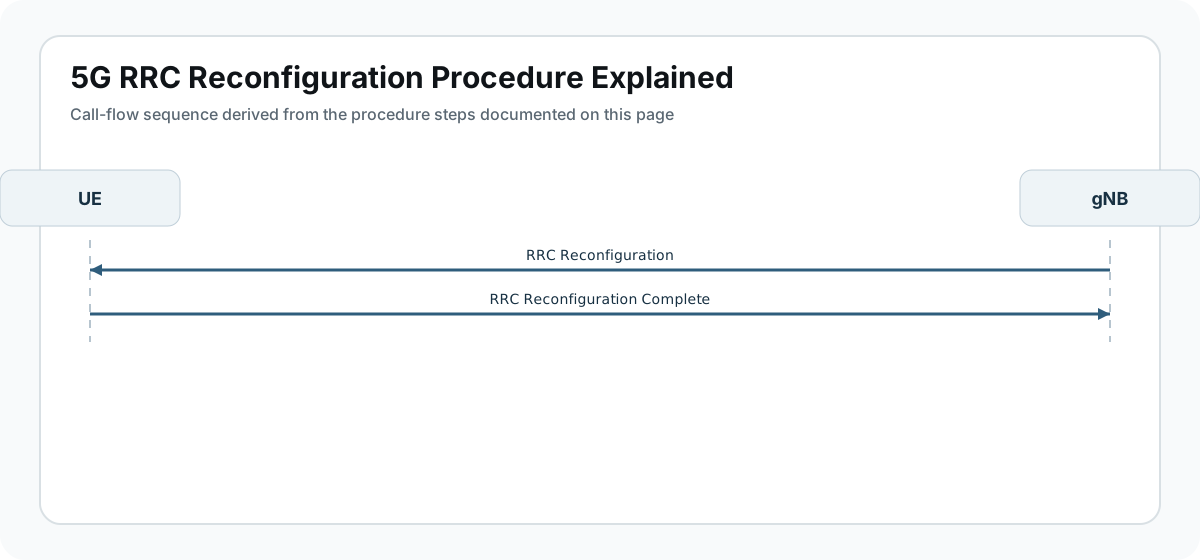
RRC Reconfiguration Call Flow
Below is the simplified signaling sequence.
UE                      gNB
 |                       |
 |<----RRC Reconfiguration----|
 |                       |
 |----RRC Reconfiguration Complete---->|
After this procedure, the new radio configuration becomes active.
Step-by-Step Explanation
Step 1: RRC Reconfiguration
The gNB sends an RRC Reconfiguration message to the UE.
This message may include several configuration elements such as:
- Data Radio Bearer (DRB) setup
- measurement configuration
- mobility parameters
- secondary cell configuration
Important parameters to check
Engineers should verify:
- DRB configuration
- QoS flow mapping
- measurement configuration
- carrier configuration
Step 2: UE Applies Configuration
The UE processes the received configuration and applies the new radio parameters.
These parameters may affect:
- scheduling
- QoS flows
- carrier aggregation
- mobility measurements
Important parameters to check
Check:
- UE capability compatibility
- radio bearer activation
- measurement configuration validity
Step 3: RRC Reconfiguration Complete
The UE sends RRC Reconfiguration Complete to the gNB.
This confirms that the UE has successfully applied the configuration.
Important parameters to check
Verify:
- message integrity
- configuration success
- UE synchronization
Common Use Cases of RRC Reconfiguration
| Use Case | Description |
|---|---|
| DRB Setup | Enable data transmission |
| Mobility Configuration | Configure handover measurements |
| Carrier Aggregation | Activate additional carriers |
| Dual Connectivity | Connect to multiple base stations |
Troubleshooting RRC Reconfiguration
Configuration Failure
Possible causes:
- UE capability mismatch
- incorrect radio parameters
- unsupported configuration
Data Bearer Setup Failure
Possible reasons:
- QoS configuration mismatch
- scheduler resource limitation
- incorrect bearer mapping
UE Does Not Respond
Possible causes:
- radio link failure
- configuration processing error
- signaling message loss
Key Messages in RRC Reconfiguration
| Message | Purpose |
|---|---|
| RRC Reconfiguration | Network sends updated configuration |
| RRC Reconfiguration Complete | UE confirms configuration |
Relevant 3GPP Specifications
The RRC Reconfiguration procedure is defined by the 3rd Generation Partnership Project in:
- 3GPP TS 38.331 - NR RRC Protocol
- 3GPP TS 38.300 - NR Overall Description
Summary
The RRC Reconfiguration procedure allows the 5G network to dynamically modify the radio configuration of a UE while it remains connected.
The process includes:
- gNB sending RRC Reconfiguration
- UE applying the new configuration
- UE responding with RRC Reconfiguration Complete
This mechanism enables flexible radio resource management and efficient service delivery in 5G networks.