5G Integrity Protection Procedure Explained
Introduction
In 5G networks, Integrity Protection ensures that signaling messages exchanged between the User Equipment (UE) and the network are not modified or tampered with during transmission.
Integrity protection allows the receiving entity to verify that a message:
- was sent by a legitimate source
- has not been altered during transmission
This mechanism is critical for maintaining secure signaling communication in mobile networks.
The procedure is defined by the 3rd Generation Partnership Project in:
- 3GPP TS 33.501 - 5G Security Architecture
- 3GPP TS 24.501 - NAS Protocol
- 3GPP TS 38.331 - RRC Protocol
Why Integrity Protection Is Needed
Without integrity protection, attackers could:
- modify signaling messages
- inject malicious commands
- disrupt network operations
Integrity protection ensures that any modification to a message can be detected immediately.
This is especially important for control-plane signaling messages.
Network Functions Involved
UE (User Equipment)
Applies integrity protection to signaling messages sent to the network.
gNB (Next Generation NodeB)
Handles integrity protection for Access Stratum (AS) signaling.
AMF (Access and Mobility Management Function)
Manages integrity protection for NAS signaling.
Interfaces Used
| Interface | Description |
|---|---|
| NR-Uu | Radio interface between UE and gNB |
| N1 | NAS signaling between UE and AMF |
| N2 | Interface between gNB and AMF |
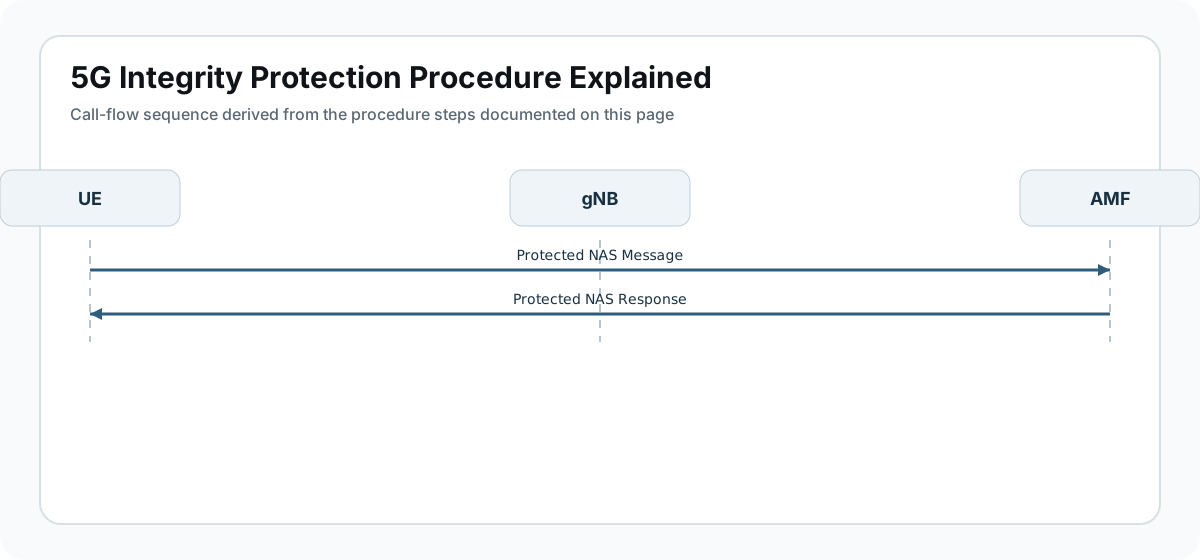
Integrity Protection Call Flow
Below is the simplified signaling sequence.
UE             gNB             AMF
 |              |               |
 |--Protected NAS Message----->|
 |              |-------------->|
 |              |               |
 |<--Protected NAS Response----|
All signaling messages include an integrity check value (MAC-I).
Step-by-Step Explanation
Step 1: Integrity Key Derivation
Integrity protection uses keys derived during the key derivation procedure.
Typical integrity keys include:
| Key | Purpose |
|---|---|
| K_NASint | NAS signaling integrity |
| K_RRCint | RRC signaling integrity |
Important parameters to check
Engineers should verify:
- key derivation parameters
- security context validity
- algorithm compatibility
Step 2: Integrity Algorithm Selection
During the Security Mode procedure, the network selects the integrity algorithm.
Common algorithms include:
| Algorithm | Description |
|---|---|
| 128-NIA0 | No integrity protection |
| 128-NIA1 | SNOW 3G based algorithm |
| 128-NIA2 | AES based algorithm |
| 128-NIA3 | ZUC based algorithm |
Important parameters to check
Check:
- UE algorithm support
- algorithm priority configuration
- network security policy
Step 3: Message Integrity Calculation
Before transmitting a signaling message, the sender calculates an integrity check value (MAC-I) using:
- integrity key
- message content
- sequence number
Important parameters to check
Verify:
- correct sequence numbers
- message authentication code generation
- synchronization status
Step 4: Integrity Verification
The receiving entity recalculates the integrity check value and compares it with the received MAC-I.
If the values match:
- the message is accepted
If the values do not match:
- the message is rejected
Important parameters to check
Check:
- MAC-I validation
- sequence number synchronization
- message integrity status
Integrity Protection in 5G Layers
| Layer | Integrity Protection |
|---|---|
| NAS Layer | Protected using K_NASint |
| RRC Layer | Protected using K_RRCint |
| User Plane | Integrity optional |
Integrity Protection Example
A protected message typically contains:
| Field | Description |
|---|---|
| Sequence Number | Prevent replay attacks |
| Message Content | Signaling information |
| MAC-I | Integrity check value |
Troubleshooting Integrity Issues
Integrity Check Failure
Possible causes:
- incorrect integrity key
- sequence number mismatch
- message corruption
Message Rejection
Possible reasons:
- MAC-I mismatch
- security context desynchronization
- algorithm mismatch
Replay Attack Detection
Possible causes:
- reused sequence numbers
- delayed signaling messages
- malicious traffic injection
Relevant 3GPP Specifications
The Integrity Protection mechanism is defined by the 3rd Generation Partnership Project in:
- 3GPP TS 33.501 - Security Architecture
- 3GPP TS 24.501 - NAS Protocol
- 3GPP TS 38.331 - NR RRC Protocol
Summary
The Integrity Protection procedure ensures that signaling messages exchanged between the UE and the network remain authentic and unchanged.
The process includes:
- deriving integrity protection keys
- selecting integrity algorithms
- generating integrity check values
- verifying message authenticity
This mechanism protects 5G networks from message tampering and signaling attacks, ensuring secure communication.