5G Idle Mode Mobility Explained
Introduction
In 5G networks, Idle Mode Mobility allows a User Equipment (UE) to move between cells while maintaining connectivity with the network without having an active signaling connection.
When a UE is in Idle Mode, it does not maintain an active RRC connection with the base station. Instead, the UE independently selects and reselects cells based on signal quality and network configuration.
This mechanism ensures that:
- the UE remains reachable for paging
- network resources are conserved
- mobility is handled efficiently without continuous signaling
Idle mode mobility procedures are defined by the 3rd Generation Partnership Project in:
- 3GPP TS 38.304 - Idle Mode Mobility
- 3GPP TS 38.331 - RRC Protocol
- 3GPP TS 23.502 - 5G System Procedures
UE States in 5G Mobility
| State | Description |
|---|---|
| RRC Idle | UE is registered but has no active signaling connection |
| RRC Connected | UE maintains an active connection with the gNB |
Idle Mode Mobility applies when the UE is in RRC Idle state.
Why Idle Mode Mobility Is Important
Idle mode mobility allows the UE to move between cells without constant signaling with the network.
Benefits include:
- reduced signaling overhead
- improved battery efficiency
- efficient network resource usage
- seamless user mobility
Key Concepts in Idle Mode Mobility
Several concepts are important for understanding this procedure.
Cell Selection
When the UE powers on, it searches for a suitable cell based on:
- signal strength
- broadcast system information
- PLMN availability
Cell Reselection
If a neighboring cell provides better radio conditions, the UE automatically switches to that cell.
This process is called cell reselection.
Tracking Area
Cells are grouped into Tracking Areas (TA).
When a UE moves to a new tracking area, the UE performs a Mobility Registration Update.
Idle Mode Mobility Call Flow
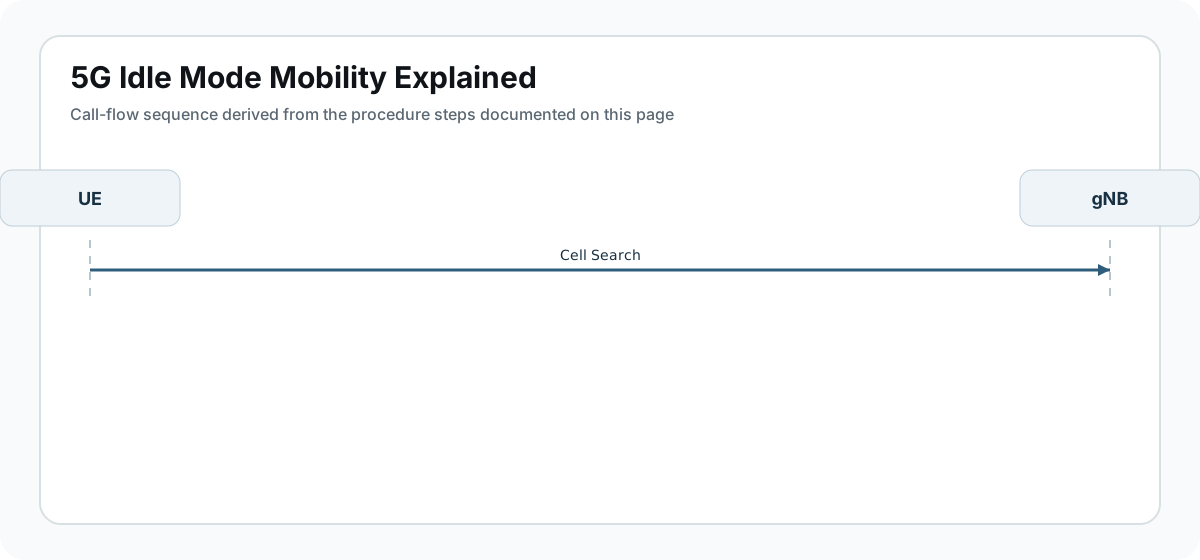
Although idle mobility does not involve continuous signaling, the typical sequence looks like this.
UE                gNB
 |                 |
 |---Cell Search-->|
 |                 |
 |---Cell Selection|
 |                 |
 |---Cell Reselection (if needed)
 |                 |
 |---Tracking Area Update (if TA changes)
Most of the mobility decisions are performed locally by the UE.
Step-by-Step Explanation
Step 1: Cell Search
The UE scans available frequencies to detect nearby NR cells.
The UE reads:
- synchronization signals
- system information blocks (SIB)
Important parameters to check
Engineers should verify:
- SSB frequency
- synchronization signal quality
- detected PLMN
Step 2: Cell Selection
The UE selects the best suitable cell based on:
- signal strength
- cell selection criteria
The UE camps on the selected cell.
Important parameters to check
Look for:
- RSRP (Reference Signal Received Power)
- RSRQ (Reference Signal Received Quality)
- SNR
Step 3: Cell Reselection
If a neighboring cell becomes better than the serving cell, the UE performs cell reselection.
The UE compares:
- serving cell quality
- neighbor cell measurements
Important parameters to check
Check:
- reselection thresholds
- neighbor cell priorities
- measurement reports
Step 4: Tracking Area Update
If the new cell belongs to a different Tracking Area, the UE must update its location.
This triggers the Mobility Registration Update procedure.
Important parameters to check
Verify:
- Tracking Area Identity (TAI)
- Registration Area list
- Mobility timers
Cell Reselection Criteria
| Parameter | Description |
|---|---|
| RSRP | Signal power level |
| RSRQ | Signal quality |
| SNR | Signal-to-noise ratio |
| Priority levels | Operator-defined cell priorities |
Idle Mode vs Connected Mode Mobility
| Feature | Idle Mode Mobility | Connected Mode Mobility |
|---|---|---|
| RRC state | Idle | Connected |
| Decision entity | UE | Network |
| Signaling | Minimal | Extensive |
| Example procedure | Cell reselection | Handover |
Troubleshooting Idle Mode Mobility
Frequent Cell Reselection
Possible causes:
- incorrect reselection parameters
- neighbor list configuration issues
- radio interference
UE Cannot Find Cell
Possible reasons:
- incorrect frequency configuration
- missing system information blocks
- hardware issues
Paging Failure
Possible causes:
- UE in wrong tracking area
- incorrect TAI list
- mobility update failure
Key Parameters for Engineers
| Parameter | Purpose |
|---|---|
| RSRP | Signal power measurement |
| RSRQ | Signal quality |
| SNR | Noise level indicator |
| Cell priority | Determines preferred cells |
| TAI | Tracking area identity |
Relevant 3GPP Specifications
The Idle Mode Mobility procedure is defined in the standards from the 3rd Generation Partnership Project:
- 3GPP TS 38.304 - Idle Mode Mobility
- 3GPP TS 38.331 - RRC Protocol
- 3GPP TS 23.502 - 5G System Procedures
Summary
The Idle Mode Mobility procedure allows a UE to move between cells efficiently without maintaining an active connection to the network.
The UE performs:
- cell selection
- cell reselection
- tracking area updates when needed
This mechanism ensures that the UE remains reachable while minimizing signaling overhead and preserving device battery life.