5G NR SSB - Synchronization Signal Block
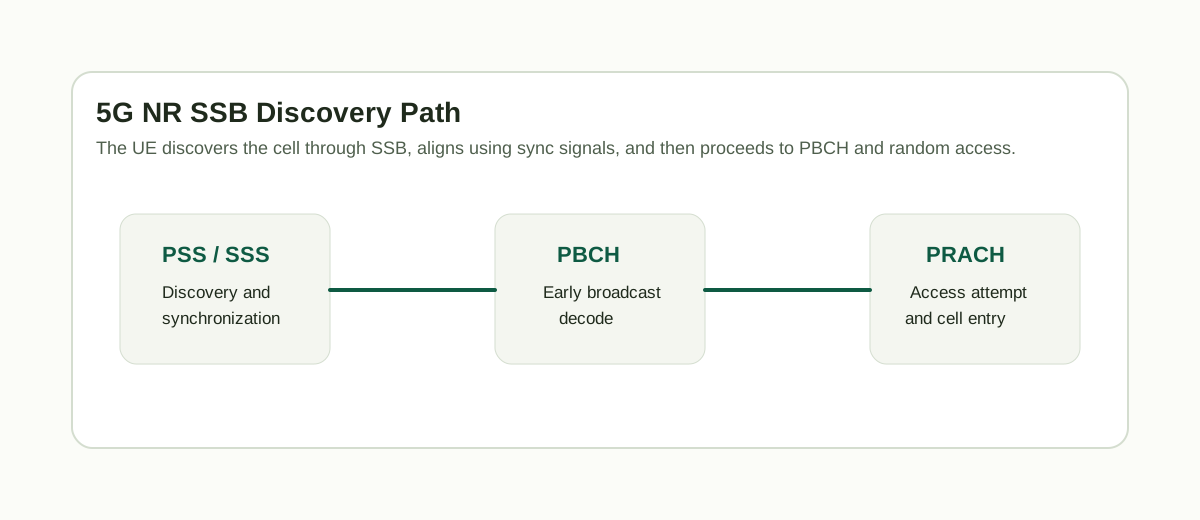
The 5G NR SSB, or Synchronization Signal Block, is the discovery structure the UE uses to find an NR cell, obtain time and frequency alignment, identify beam direction, and start the early broadcast path.
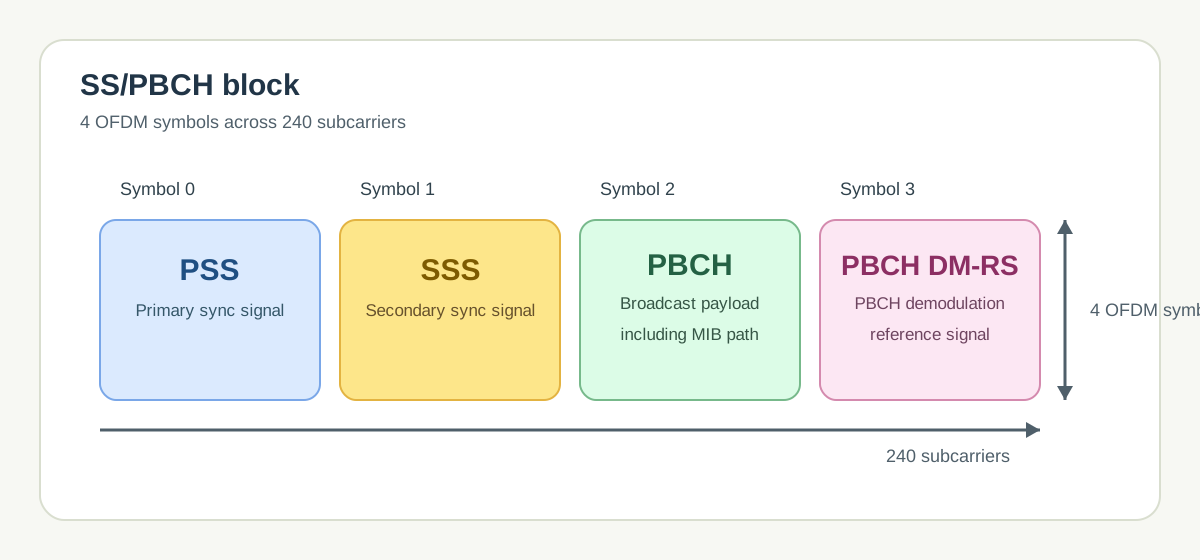
Read SSB as the full SS/PBCH block rather than only as a synchronization signal. It combines PSS, SSS, PBCH, and PBCH DM-RS, and it anchors cell search, beam sweeping, MIB recovery through PBCH, and the move into PRACH.
| Technology | 5G NR |
|---|---|
| Full name | Synchronization Signal Block |
| Main specs | 3GPP TS 38.211, 38.213, 38.331, 38.300 |
| Release | Release 18 |
| Main contents | PSS, SSS, PBCH, PBCH DM-RS |
| Core shape | 4 OFDM symbols over 240 subcarriers |
| Main use | Cell search, synchronization, beam visibility, and early broadcast decode |
| Related pages | PBCH, PRACH, Beamforming, Frame Structure, Numerology, ARFCN |
Contents
Overview
SSB is the first downlink structure a UE searches for during cell discovery. It supports synchronization, cell identity recovery, beam visibility, and the first successful decode of the broadcast path.
- SSB is built from PSS, SSS, PBCH, and PBCH DM-RS.
- It is transmitted as one or more candidate SS/PBCH blocks in a burst pattern.
- It is tied to beam sweeping in many deployments, especially in higher-frequency operation.
- It leads directly into PBCH decoding and then into PRACH.
- It is also the anchor for SSB-based measurements and beam-aware mobility reading.
Quick interpretation
| Role | Discovery, synchronization, beam visibility, and early broadcast entry path |
|---|---|
| Main contents | PSS, SSS, PBCH, and PBCH DM-RS inside one SS/PBCH block |
| Main frequency-time shape | 4 OFDM symbols over 240 subcarriers |
| Configuration view | absoluteFrequencySSB, ssbSubcarrierSpacing, and ssb-PositionsInBurst shape where and when the UE expects SSBs |
| Main reading points | Detection success, beam index, burst timing, PBCH decode, and measurement quality |
| Main impact | Initial access readiness, beam selection, measurement quality, and early mobility behavior |
How the SSB model works
The SSB model combines synchronization, broadcast delivery, and beam visibility in one compact structure. The UE searches for candidate SS/PBCH blocks, identifies the cell with PSS and SSS, and then decodes PBCH to recover the MIB.
SS/PBCH block structure
One SS/PBCH block occupies four OFDM symbols and 240 subcarriers. The block contains the two synchronization signals plus the physical broadcast channel and its demodulation reference signal. This fixed shape is why SSB is easy to recognize in grid-level analysis even when later channels are not yet active.
Frequency position and raster context
SSB frequency placement is tied to the synchronization raster and to serving-cell configuration. In practice,
the most useful reading path is to combine carrier frequency,
absoluteFrequencySSB, and ssbSubcarrierSpacing with the expected band and
deployment mode.
Release 18 serving-cell configuration keeps the SSB subcarrier-spacing choices compact: FR1 uses 15 or 30 kHz, FR2-1 and FR2-NTN use 120 or 240 kHz, and FR2-2 adds higher SSB spacing options.
Burst sets and SSB indexes
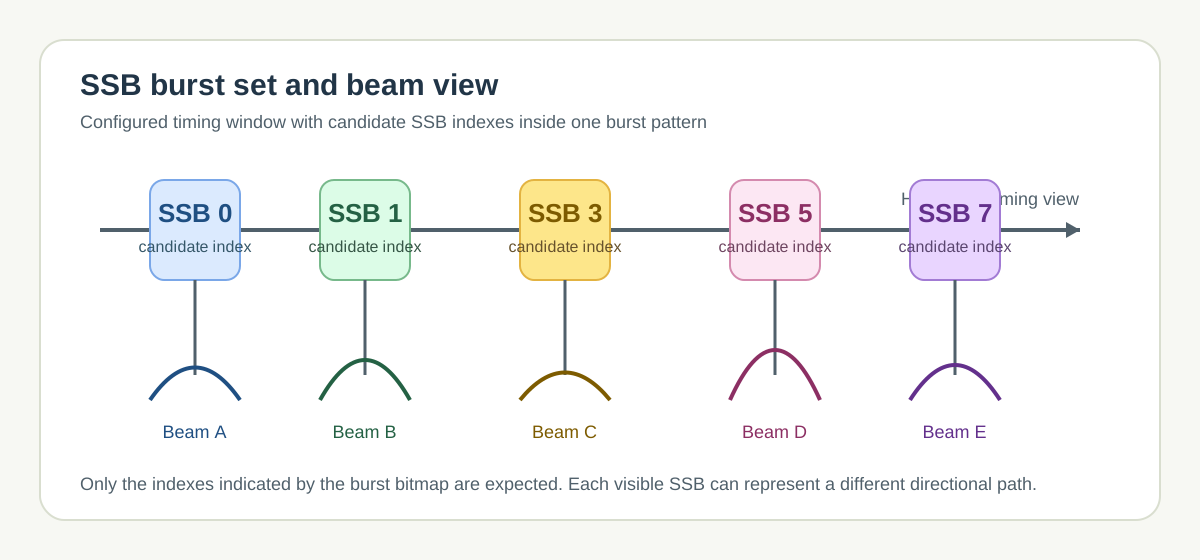
SSBs are transmitted in burst sets rather than as a continuous unbroken stream. The network indicates expected
SSB indexes through ssb-PositionsInBurst. That bitmap tells the UE which candidate block indexes
may appear inside the configured burst timing.
Beam sweeping
Different SSB indexes can correspond to different transmit beams. That makes SSB one of the first places where directional coverage appears in logs and measurements. If one SSB index is consistently strong while others are weak, the issue is often directional coverage rather than a generic carrier-level problem.
| Element | What it means in SSB reading |
|---|---|
| PSS | Gives the UE an early synchronization anchor and part of the physical-cell-identity recovery path |
| SSS | Completes physical-cell-identity determination and refines synchronization context |
| PBCH | Delivers the early broadcast payload after successful SSB detection |
| PBCH DM-RS | Supports PBCH demodulation and reliable MIB recovery |
ssb-PositionsInBurst | Defines which candidate SSB indexes are expected in the burst set |
ssbSubcarrierSpacing | Defines the SSB numerology scale used for search, timing, and grid interpretation |
absoluteFrequencySSB | Places SSB in frequency and ties the sync raster to the configured carrier |
Operational view
Read SSB as a live operating structure, not only as a static definition. It affects discovery speed, beam choice, measurement quality, and the transition from idle search to access readiness.
Cell search and synchronization
The UE searches for candidate SSB locations, detects the synchronization signals, determines cell identity, and aligns its timing and frequency reference. If this stage is unstable, later channels may never become the real problem because the entry path is already weak.
Beam-aware discovery
In directional deployments, one SSB does not always represent the whole cell. What matters is which SSB index is detected, how stable it is over time, and whether the beam linked to that index supports a clean path into PBCH and PRACH.
Measurement use
SSB-based measurements feed cell selection, reselection, mobility reading, beam management, and coverage interpretation. That is why poor SSB quality can show up as unstable access, weak beam ranking, or mobility anomalies even when later scheduled channels look normal in short snapshots.
FR1 and FR2 reading differences
FR1 usually presents a smaller candidate set and wider coverage expectation per visible SSB. FR2 often makes SSB reading more beam-dependent, with larger candidate sets, narrower beam coverage, and stronger sensitivity to alignment, blockage, and burst timing.
| Reading area | Why it matters |
|---|---|
| Detection stability | Shows whether the UE can repeatedly find the cell at the expected time and frequency position |
| Beam-linked SSB index | Shows which directional path is actually usable for discovery and early access |
| PBCH follow-up | Shows whether discovery is strong enough to continue into broadcast decoding |
| Burst timing | Shows whether the UE is looking at the right discovery opportunities and periodicity |
| Measurement consistency | Shows whether mobility and beam decisions are built on a stable SSB view |
Where SSB appears in real procedures
Initial access
Cell search -> SSB detection -> PBCH decode -> MIB available -> PRACH path -> RRC setupThis is the main SSB procedure path. Discovery starts here, broadcast context follows through PBCH, and only then can the UE move into PRACH and later setup stages.
Beam management
Configured burst pattern -> visible SSB indexes -> beam ranking -> beam-aware access and later trackingIn beam-based operation, SSB is part of the first beam-management view. Read it together with beamforming rather than as a standalone synchronization topic.
Measurements and mobility
SSB measurements -> serving and neighbor comparison -> mobility decisions -> beam and cell continuitySSB measurement quality also matters beyond initial access. It stays relevant for coverage interpretation, neighbor comparison, and mobility behavior.
Troubleshooting
Start with the SSB path when the symptom appears before scheduled traffic is stable, when access success varies strongly by location or direction, or when beam behavior looks inconsistent from one burst set to the next.
- Check whether the expected SSB indexes are present at the configured timing.
- Check whether the visible SSB index matches the expected beam direction.
- Check whether PBCH decoding follows successful SSB detection.
- Check whether frequency placement and
ssbSubcarrierSpacingmatch the actual serving-cell setup. - Check whether weak access starts before PRACH rather than during PRACH itself.
| Symptom | What to inspect first |
|---|---|
| Cell not found or found late | Expected burst timing, candidate SSB indexes, and whether the UE sees the correct frequency position |
| One location works, another does not | Beam-linked SSB visibility, directional coverage, blockage, and beam-specific quality differences |
| SSB detected but access still fails | Whether PBCH decode succeeds and whether the path into PRACH is ready after the broadcast step |
| Measurements look unstable | Whether the same SSB index is being tracked consistently and whether burst timing is sampled correctly |
| FR2 discovery is intermittent | Beam alignment, burst opportunity timing, directional blockage, and whether the right SSB candidate set is configured |
Common reading mistakes
- Treating SSB as only PSS and SSS while ignoring PBCH and PBCH DM-RS.
- Assuming one visible SSB represents all beam directions equally well.
- Jumping directly to RRC or NAS analysis before checking whether the discovery path was already weak.
- Reading ARFCN and SSB placement separately instead of correlating carrier frequency with sync-raster position.
- Explaining access failure only through PRACH when the earlier SSB or PBCH step was unstable.
References
- 3GPP TS 38.211 Release 18 - SS/PBCH block physical mapping, synchronization signals, and PBCH structure
- 3GPP TS 38.213 Release 18 - cell search, candidate SSB indexes, burst timing, and control-procedure context
- 3GPP TS 38.331 Release 18 - MIB,
absoluteFrequencySSB,ssbSubcarrierSpacing, andssb-PositionsInBurstconfiguration - 3GPP TS 38.300 Release 18 - overall NR and NG-RAN architecture context for initial access and measurements
FAQ
What is SSB in 5G NR?
SSB is the Synchronization Signal Block. It is the structure the UE uses for cell search, synchronization, beam visibility, and the start of PBCH decoding.
What is inside an SSB?
An SSB contains PSS, SSS, PBCH, and PBCH DM-RS inside one SS/PBCH block.
How is SSB related to PBCH?
PBCH is carried inside the SS/PBCH block. After SSB detection and alignment, the UE decodes PBCH and obtains the MIB.
Why is SSB important before PRACH?
Because the UE normally needs the discovery and early broadcast path first. Without a usable SSB and PBCH path, the move into PRACH can be delayed, misaligned, or blocked.
Why does SSB matter for beam-based operation?
Because different SSB indexes can represent different beam directions. That makes SSB one of the first places where directional coverage and beam-specific behavior become visible.
What should I inspect first when SSB looks weak?
Start with burst timing, expected SSB indexes, beam-linked visibility, PBCH follow-up, and whether frequency placement matches the configured serving cell.