5G NR PTRS - Phase Tracking Reference Signal
The 5G NR PTRS, or Phase Tracking Reference Signal, is a reference signal used to help the receiver track phase-related impairments during shared-channel reception. In practical engineering work, PTRS becomes especially relevant when operating conditions make decoding more sensitive to phase behavior.
For beginners, PTRS is a signal that helps the receiver stay aligned when phase-related problems would otherwise make decoding harder. For experienced engineers, it is where phase-noise-sensitive operation, higher-order modulation, high-frequency deployment behavior, and overhead tradeoffs become very practical.
| Full name | Phase Tracking Reference Signal |
|---|---|
| Main specs | 3GPP TS 38.211, 38.214 |
| Main concepts | Phase tracking, phase noise, shared-channel support, overhead, high-frequency robustness |
| Why it matters | PTRS helps the receiver handle phase-related impairments more effectively so shared-channel decoding remains more reliable in demanding conditions |
What PTRS means in simple terms
In practical engineering language, PTRS is the reference support used when the receiver needs help keeping up with phase behavior that can distort the signal. Without that support, a scheduled transmission may become much harder to decode cleanly.
- PTRS focuses on phase tracking, not general payload delivery.
- It is tied to shared-channel decoding conditions.
- It becomes more important when operating conditions are phase-noise-sensitive.
- Engineers inspect PTRS when decode quality degrades in situations where phase behavior is likely to matter.
Technical summary
| Role | Reference-signal support for phase tracking during scheduled shared-channel decoding |
|---|---|
| Main practical use | Improve decode robustness when phase-related impairments would otherwise reduce reliability |
| Main engineering inputs | Frequency range, modulation demands, phase-noise sensitivity, shared-channel configuration, overhead limits |
| Main engineering outputs | Better phase tracking, improved decode quality in demanding cases, more stable higher-order operation |
| Linked topics | DMRS, PDSCH, PUSCH, OFDM, throughput analysis, high-frequency deployment behavior |
How PTRS works in practice
Engineers should read PTRS as a phase-stability support signal. It is not there to replace DMRS or carry payload. Instead, it helps the receiver maintain a more usable phase view of the transmission when operating conditions make phase behavior a real problem.
Phase-tracking support
Some radio conditions make phase behavior harder to ignore. PTRS gives the receiver extra support so it can correct for that behavior more effectively during decoding.
Shared-channel relevance
PTRS is usually discussed together with shared channels such as PDSCH and PUSCH. If those channels are using demanding configurations, PTRS may become part of the explanation for why decode quality is good or bad.
Overhead tradeoff
Like other reference signals, PTRS consumes resources. That means engineers should always think in terms of the tradeoff between stronger support and reduced net payload efficiency.
| Concept | What it means in practice |
|---|---|
| Phase tracking | The receiver’s effort to stay aligned with phase-related behavior that can distort decoding |
| Phase-sensitive operation | The kind of operating condition where decode quality can degrade because phase behavior is harder to ignore |
| PTRS placement | The resources reserved to give the receiver phase-tracking support |
| Decode robustness | The practical improvement in decoding reliability when phase-tracking support is effective |
| Overhead | The payload efficiency cost paid to gain stronger phase-tracking support |
PTRS formats and operational variants
PTRS is most useful to compare through its usage and density variants. Engineers usually want to know when PTRS becomes necessary and how much support is being provided.
| Variant | What engineers should know |
|---|---|
| Downlink PTRS view | Used when PDSCH decode quality needs stronger phase-tracking support under demanding downlink conditions |
| Uplink PTRS view | Used when PUSCH decode quality needs stronger phase-tracking support on the uplink side |
| Lower PTRS density | Less overhead, but potentially weaker phase-tracking support in challenging operating conditions |
| Higher PTRS density | Stronger phase-tracking support at the cost of more overhead and less net payload efficiency |
| Moderate operating condition | PTRS may be less critical if phase-related impairments are not the main decode limitation |
| Demanding operating condition | PTRS becomes more relevant when high frequency, higher-order modulation, or phase sensitivity make decoding more fragile |
Where PTRS appears in real procedures
Downlink shared-channel decode path
PDCCH assignment -> PDSCH with DMRS / PTRS support -> phase-aware decode -> HARQ resultIn demanding downlink cases, PTRS may be part of the reason a higher-order or more sensitive transmission can still be decoded reliably.
Uplink shared-channel decode path
Uplink grant -> PUSCH with DMRS / PTRS support -> phase-aware decode at gNB -> uplink decode resultOn the uplink side, PTRS can also contribute to more robust decoding where phase-related behavior would otherwise weaken the result.
Performance and modulation-sensitive workflows
PTRS is most visible in workflows where decode robustness and payload efficiency are both under pressure, so engineers need to understand whether stronger phase-tracking support is worth the overhead.
Real-world engineering examples
Example 1: Why a demanding modulation setup still decodes reliably
In some cases the difference is not only MCS choice or DMRS support, but whether PTRS is helping the receiver manage phase-sensitive conditions more effectively.
Example 2: Why throughput drops when robustness goes up
Throughput can fall slightly because extra reference support such as PTRS consumes resources that are no longer available for payload.
Example 3: Why high-frequency or higher-order cases behave differently
Some operating conditions make phase-related behavior a much bigger factor, so PTRS becomes more visible in the performance result than it would in a simpler operating case.
What to check in logs, counters, and traces
- whether the operating condition is one where phase-tracking support is likely to matter
- whether PTRS is configured and present where expected
- whether the shared-channel decode issue still exists after accounting for phase-related support
- whether higher-order modulation or higher-frequency operation is increasing sensitivity
- whether the payload-efficiency drop matches the expected PTRS overhead
- whether the problem is really PTRS-related or is still better explained by DMRS, radio quality, or control issues
| Symptom | What to inspect first |
|---|---|
| Decode instability in demanding conditions | Whether PTRS support is present and strong enough for the phase-sensitive operating case |
| Lower throughput than expected | Whether extra reference-signal support including PTRS is consuming more payload resources |
| Good channel-estimation support but weak decode quality | Whether the missing factor is phase-tracking support rather than standard channel estimation |
| Frequency-dependent performance drop | Whether phase-sensitive operating conditions are making PTRS more important in that band or scenario |
Common mistakes engineers make with PTRS
- treating PTRS like a duplicate of DMRS instead of a phase-tracking support signal
- ignoring phase-sensitive operating conditions when troubleshooting shared-channel decode issues
- forgetting that extra robustness can reduce payload efficiency
- assuming PTRS matters equally in every deployment condition
- blaming PTRS first when the real root cause is still control delivery, radio quality, or channel-estimation quality
Beginner takeaway
PTRS is the phase-tracking reference signal in 5G NR. It helps the receiver stay stable when phase-related behavior would otherwise make shared-channel decoding harder.
Advanced engineer notes
- PTRS becomes most useful when the standard decode path is no longer limited only by channel estimation.
- Engineers should think of PTRS as a robustness tool for demanding conditions, not as a universally dominant reference signal.
- Payload-efficiency calculations should include PTRS overhead when comparing theoretical and practical throughput.
- High-frequency and higher-order operation are often where PTRS becomes easiest to justify in real analysis.
FAQ
What does PTRS do in 5G NR?
PTRS helps the receiver track phase-related impairments so shared-channel decoding can remain more reliable in demanding conditions.
How is PTRS different from DMRS?
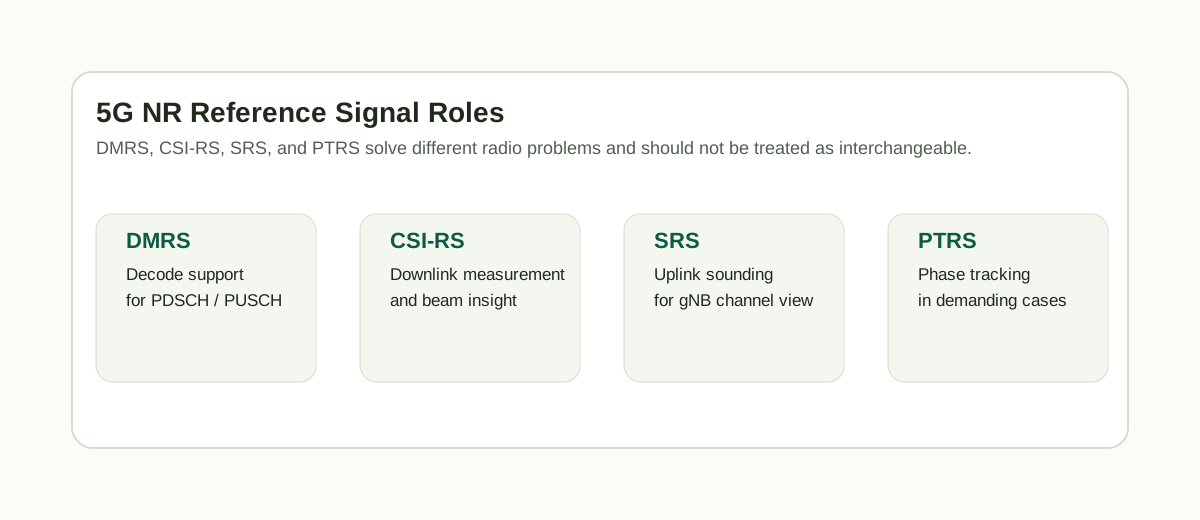
DMRS is mainly for channel estimation during demodulation, while PTRS specifically helps with phase-tracking behavior that can also affect decoding quality.
Why can PTRS affect throughput?
Because PTRS consumes resources that could otherwise carry payload, even though it can improve decode robustness in return.
When does PTRS become more important?
It becomes more visible when operating conditions are more sensitive to phase-related behavior, such as higher-frequency or higher-order cases.
What should I inspect first when decode quality degrades in demanding radio conditions?
Start by checking whether the issue may be phase-related and whether PTRS support is present and strong enough for the operating condition.
Is PTRS a payload-bearing channel?
No. PTRS is a reference-signal feature used to support more stable decoding, not to carry user payload.
Use the related PHY pages naturally in this workflow
Pair this page with DMRS when you want to separate channel-estimation issues from phase-tracking issues, and read it together with PDSCH or PUSCH when you are investigating shared-channel decode robustness.