5G NR PDCCH - Physical Downlink Control Channel
The 5G NR PDCCH, or Physical Downlink Control Channel, is the control channel that tells the UE what radio actions to take next. It carries scheduling-related control information so the UE knows when to receive downlink data, when to transmit uplink data, and how to interpret important control decisions from the gNB.
This page covers the control-delivery path used before many real data transmissions. It ties together CORESET design, search-space monitoring, DCI decoding, blind decoding load, aggregation level, and control coverage.
| Technology | 5G NR |
|---|---|
| Full name | Physical Downlink Control Channel |
| Main specs | 3GPP TS 38.211, 38.212, 38.213, 38.214 |
| Release | Release 18 |
| Main concepts | CORESET, search space, REG, CCE, DCI, blind decoding, aggregation level |
| Why it matters | PDCCH delivers control before PDSCH or grant-based PUSCH activity can happen |
Contents
Overview
In plain language, PDCCH is the control channel the UE listens to before it can act on many radio resources. If the UE cannot monitor and decode the right control information, it may miss its downlink data, miss its uplink grant, or fail to follow scheduling decisions correctly.
- PDCCH tells the UE where and when data is scheduled.
- It carries DCI, which contains scheduling and control instructions.
- It is monitored inside configured control-resource regions.
- PDCCH behavior depends on numerology, BWP, CORESET, and search-space setup.
Quick interpretation
| Role | Downlink control delivery for scheduling and radio actions |
|---|---|
| Carries | DCI for downlink assignments, uplink grants, HARQ-related control, and other scheduling context |
| Mapped in | Configured CORESET resources within the active BWP |
| UE behavior | Monitor search spaces, attempt blind decoding, validate CRC, then act on decoded control |
| Main impact | Scheduling efficiency, control coverage, throughput stability, uplink grant behavior, and paging/access reliability |
How the PDCCH model works
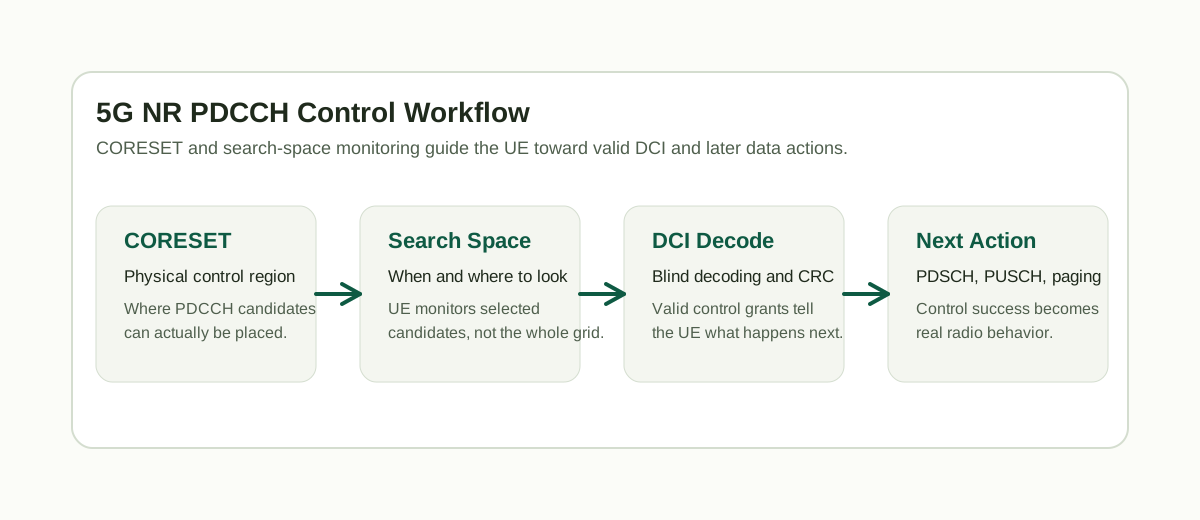
Read PDCCH as a control monitoring workflow, not just a channel name. The network first defines where control can exist, then tells the UE when to look, and finally sends DCI that drives the next radio action.
CORESET
CORESET, or Control Resource Set, defines the physical control region where PDCCH candidates may be placed. It is the actual time-frequency area reserved for control.
Search space
Search space tells the UE when and where to monitor for possible PDCCH candidates. A UE does not blindly search the whole carrier all the time. It follows configured search rules tied to the active control setup.
DCI and blind decoding
The UE attempts blind decoding on candidate PDCCH locations, checks the CRC, and if a valid DCI is found, it uses that information to process the next step such as a PDSCH reception or a PUSCH transmission.
REGs, CCEs, and aggregation level
PDCCH resource allocation is built from resource element groups and control channel elements. Aggregation level determines how many CCEs are used for one PDCCH candidate. Higher aggregation improves robustness but increases control overhead.
| Concept | What it means in practice |
|---|---|
| CORESET | The actual control-resource region where the gNB can place PDCCH |
| Search space | The monitoring rule that tells the UE which candidates to check and when |
| DCI | The decoded control payload that carries scheduling instructions |
| REG | The smallest PDCCH control-resource grouping used inside the CORESET mapping structure |
| CCE | The control-channel resource unit built from REGs and used to define candidate size |
| Aggregation level | The number of CCEs used for one candidate, trading control robustness against control overhead |
| Blind decoding | The UE tries possible candidates and validates which control message is really intended for it |
PDCCH formats and operational variants
PDCCH does not use numbered channel formats in the same way PUCCH does. In practice, the useful comparisons are control-delivery variants such as monitoring type, search-space role, and aggregation behavior.
| Variant | Meaning |
|---|---|
| Common search space | Used for common control monitoring where the UE follows broader control expectations during early or shared operation |
| UE-specific search space | Used when control monitoring is more tightly targeted to a configured UE context |
| Lower aggregation | More control efficiency but potentially less robust control decoding under weaker radio conditions |
| Higher aggregation | More robust control delivery at the cost of extra control overhead and reduced efficiency |
| Initial control context | Early control behavior tied to setup and access progression before full ongoing scheduling is established |
| Steady-state scheduling context | Regular ongoing control behavior for downlink assignments, uplink grants, and daily throughput analysis |
How PDCCH connects to numerology, BWP, and data channels
- Numerology changes timing scale and control monitoring granularity.
- Frame structure explains where the monitored slots and symbols sit in time.
- OFDM is the resource-grid model that physically carries the control region.
- Bandwidth Part (BWP) defines the active bandwidth region in which control is monitored.
- CORESET, Search Space, and DCI Formats are the three closest companion pages.
- PDCCH usually acts as the front door to later PDSCH and PUSCH activity.
A very common mistake is to analyze data scheduling in isolation. In real traces, many downlink and uplink questions should start with: did the UE receive and decode the expected PDCCH correctly?
Where PDCCH appears in real procedures
Initial access and early connected setup
SSB / PBCH -> random access -> control configuration -> PDCCH monitoring -> scheduled follow-up resourcesDuring access and early connected operation, PDCCH becomes important once the UE has enough configuration to monitor control resources and act on scheduled assignments.
Downlink data scheduling
PDCCH carrying DCI -> PDSCH assignment -> data decode -> HARQ feedbackThis is the most common practical use case. When throughput is inspected, one of the first questions is whether expected downlink assignments were successfully delivered over PDCCH.
Uplink grant behavior
PDCCH carrying UL grant -> PUSCH transmission -> gNB decode / HARQ handlingUplink traffic can also depend on PDCCH because the UE may need a valid uplink grant before transmitting on PUSCH, depending on the scheduling context.
Paging and other control-driven actions
PDCCH is also tied to other control events, including paging-related scheduling and actions where the network needs the UE to monitor and react within specific configured control opportunities.
Troubleshooting
Example 1: Good radio quality but poor throughput
A UE can report reasonable signal conditions while still seeing poor throughput if control decoding is weak, if CORESET placement is too restrictive, or if PDCCH aggregation and monitoring conditions are limiting usable scheduling opportunities.
Example 2: Missing uplink activity after setup
If the UE is expected to transmit but no useful PUSCH appears, verify whether the UE decoded the expected grant on PDCCH rather than assuming the uplink channel itself failed first.
Example 3: BWP-related confusion
If control monitoring is tied to one active BWP and traces are interpreted using total carrier bandwidth instead, the scheduling picture can look inconsistent even when the network is behaving correctly.
- active BWP and whether control monitoring assumptions match it
- configured CORESET and search-space behavior
- CCE aggregation level and whether control robustness looks stressed
- REG/CCE candidate interpretation for the expected monitoring context
- whether expected DCI was found and decoded
- PDCCH BLER or control decoding health if counters are available
- aggregation-level behavior and whether control coverage looks stressed
- whether expected PDSCH or PUSCH follows the control message
- timing alignment between control and later scheduled resources
- RRC configuration that may have changed monitoring behavior
| Symptom | What to inspect first |
|---|---|
| Good signal but weak throughput | PDCCH decoding success, DCI delivery, and actual scheduling frequency |
| Missing expected downlink data | Whether a valid PDCCH assignment appeared before the expected PDSCH |
| Missing expected uplink traffic | Whether an uplink grant was successfully delivered on PDCCH |
| Control instability after reconfiguration | BWP, CORESET, and search-space changes from recent RRC configuration |
Common mistakes
- assuming strong RSRP automatically means strong control decoding
- looking only at PDSCH and ignoring the control step that scheduled it
- confusing total carrier width with the active control-monitoring bandwidth
- treating CORESET and search space as the same thing
- forgetting that control limitations can shape throughput before data-channel limits do
References
- 3GPP TS 38.211 - NR physical channels and modulation, including PDCCH resources and DM-RS mapping
- 3GPP TS 38.212 - NR multiplexing and channel coding, including DCI coding structure
- 3GPP TS 38.213 - NR physical-layer procedures for control, including PDCCH monitoring and search-space behavior
- 3GPP TS 38.214 - NR physical-layer procedures for data, for how successful control delivery leads into shared-channel scheduling
FAQ
What does PDCCH do in 5G NR?
PDCCH carries the downlink control information that tells the UE how to handle scheduled radio activity, such as downlink assignments and uplink grants.
What is the difference between CORESET and search space?
CORESET is the physical control region. Search space is the monitoring rule that tells the UE where and when to look for possible PDCCH candidates inside that region.
Why can PDCCH affect throughput?
Without reliable control decoding, the UE may miss data assignments or uplink grants, which directly reduces effective scheduling and therefore practical throughput.
Is PDCCH only relevant for downlink?
It is a downlink control channel, but it can still affect uplink behavior because uplink grants and control actions may be delivered on PDCCH.
What should I inspect first when PDSCH seems missing?
Check whether the expected PDCCH assignment was present and decoded correctly before assuming the data channel itself is the primary issue.
How does BWP affect PDCCH?
PDCCH monitoring takes place within the configured control-resource setup of the active BWP, so the active BWP directly affects what control region the UE is using.