5G MIMO - NR Massive MIMO, Rank, Layers, Precoding, and Spatial Multiplexing
5G MIMO is the use of multiple antenna paths and spatial processing to improve radio performance in NR. In practice, it is where rank, layers, precoding, and spatial channel quality start to determine whether throughput can scale beyond a simple single-stream link.
For beginners, MIMO means 5G can use multiple spatial streams instead of treating the radio link as only one straight pipe. For experienced engineers, it is where massive MIMO, PMI, rank behavior, layer activation, and real channel separability become practical throughput and capacity topics.
| Primary keyword | 5G MIMO |
|---|---|
| Main specs | 3GPP TS 38.211, 38.214, 38.213 |
| Main concepts | NR MIMO, massive MIMO, rank, layers, precoding, SU-MIMO, MU-MIMO |
| Why it matters | MIMO is one of the main ways NR turns good spatial conditions into higher throughput and better spectral efficiency |
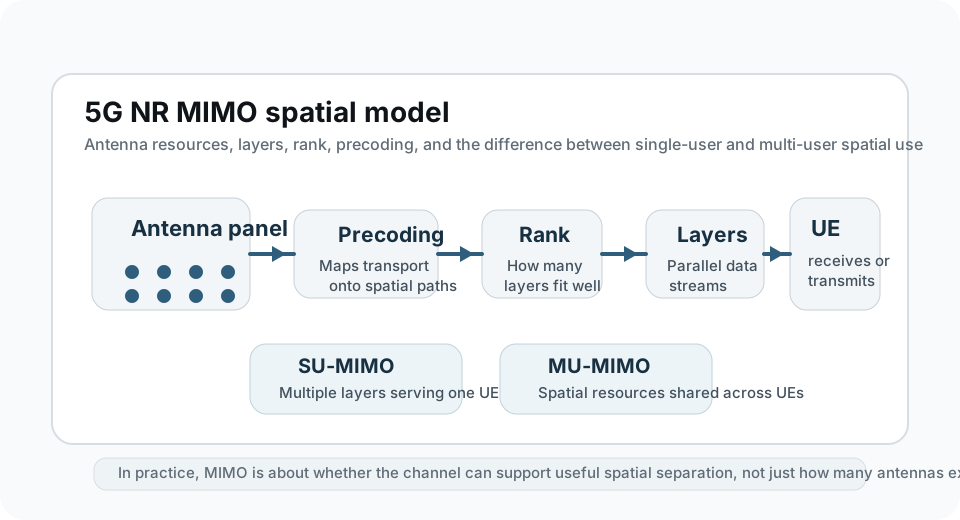
What MIMO means in simple terms
In practical terms, MIMO lets the network use spatial dimension as another performance resource. Instead of only increasing bandwidth or pushing harder coding, the system can use multiple spatial streams when the radio channel actually supports them.
- MIMO can improve throughput, efficiency, and in some cases robustness.
- Its value depends on real spatial channel quality, not only antenna count.
- Rank and layer behavior tell engineers whether the spatial opportunity is actually being used.
- Engineers inspect MIMO when throughput does not scale as expected or spatial behavior looks unstable.
Technical summary
| Role | Use spatial dimension to improve throughput and spectral efficiency |
|---|---|
| Main practical terms | Rank, layers, precoding, channel separability, SU-MIMO, MU-MIMO, massive MIMO |
| Most visible outcomes | Layer count, throughput scaling, PMI behavior, rank stability, scheduling efficiency |
| Main dependencies | Beam quality, CSI support, spatial channel condition, UE capability, scheduler policy |
| Linked topics | Beamforming, CSI-RS, PDSCH, link adaptation, throughput, HARQ |
How MIMO works in practice
Engineers should view MIMO as a spatial transport opportunity. If the channel supports enough separation, the system can carry more than one useful stream. If the spatial condition is weak or unstable, rank and layer use will collapse toward a more conservative operating point.
Rank shows spatial opportunity
Rank is the practical indicator of how many useful spatial streams the channel can support. A higher rank does not automatically mean better performance, but it signals the possibility of carrying more data streams efficiently.
Layers are the actual transport streams
Layers are how the transport is practically carried. In live analysis, engineers often talk about MIMO value in terms of how many layers are actually active and stable over time.
Precoding matters
Precoding is how the system maps the transport across the available antenna paths. This is why PMI and link adaptation matter when reading downlink MIMO behavior.
Spatial gain must survive the real channel
MIMO looks powerful on paper, but in practice its benefit depends on channel quality, UE position, beam stability, interference, and whether the network can keep spatial streams sufficiently distinct.
MIMO variants engineers should understand
| Variant | What engineers should know |
|---|---|
| Single-layer operation | The system is effectively using a conservative spatial mode even if more antennas exist |
| Multi-layer operation | Higher throughput potential when the channel supports stable spatial separation |
| SU-MIMO | Multiple layers are used to serve one UE more efficiently |
| MU-MIMO | Spatial resources are split across different UEs, which changes how efficiency is observed per user |
| Massive MIMO | Large-scale antenna resources and spatial processing improve capacity and directional control when conditions support it |
| Rank-limited operation | The channel or UE capability is stopping the system from exploiting more layers |
Where MIMO matters in real procedures
- It matters most in scheduled data transport on PDSCH and sometimes PUSCH.
- It depends on measurement support from CSI-RS and related reporting context.
- It is strongly tied to beamforming and directional channel quality.
- It becomes visible through link adaptation and rank/layer changes.
- It often appears in troubleshooting through throughput gaps and HARQ pressure when the spatial assumptions were too optimistic.
Mini sequence flow
CSI / spatial observation
   -> rank and PMI context
   -> scheduler picks layers and transport profile
   -> PDSCH / PUSCH transmission
   -> throughput and HARQ reveal whether the spatial gain was real
Real-world engineering examples
A cell may advertise high-order MIMO capability, but the user may still see only modest throughput if the channel supports only limited rank for most of the session. This is why claimed MIMO capability and usable MIMO gain should never be treated as the same thing.
Another common case is unstable layer activation. A UE may briefly use more layers, then fall back repeatedly because mobility, beam changes, or interference prevent the spatial streams from staying reliable.
What to check in logs, KPIs, and traces
- Rank behavior over time, not just a single peak value
- Actual layer usage and whether it matches expected spatial conditions
- PMI or precoding-related trends where available
- CQI, beam quality, and CSI support quality
- Throughput scaling versus layer expectations
- HARQ retransmissions that suggest the chosen spatial mode was too aggressive
- Whether the limitation is UE capability, scheduler policy, or radio reality
| Symptom | Likely engineering direction |
|---|---|
| Throughput does not scale with MIMO capability | Check actual rank and layer use, not just configured or marketed capability |
| Layer count drops frequently | Check beam stability, CSI quality, mobility effects, and interference |
| High rank is reported but decode quality is poor | Check whether the spatial assumption is too optimistic for the real channel |
| Good signal level but weak spatial gain | Check whether the channel lacks enough separability even though average power looks fine |
Common mistakes engineers make with MIMO
- Assuming more antennas automatically means more user throughput.
- Confusing beamforming gain with true multi-layer spatial gain.
- Reading peak rank values as if they represent stable real-world operation.
- Ignoring HARQ and decode outcomes when evaluating MIMO benefit.
Beginner takeaway
MIMO is how 5G NR uses spatial dimension to carry data more efficiently. Its real value depends on whether the channel can support useful layers in practice, not just in theory.
Advanced engineer notes
- Rank is an opportunity indicator, not a guarantee of stable throughput gain.
- Massive MIMO value depends on channel separability, scheduler intelligence, and beam quality, not only array size.
- Many “MIMO problems” are really beam, CSI, or adaptation problems seen through a spatial lens.
- Per-user throughput in MU-MIMO analysis should be interpreted differently from whole-cell efficiency gain.
FAQ
What is MIMO in 5G NR?
It is the use of multiple spatial paths and antenna resources to improve transport efficiency and capacity.
What is the difference between rank and layers?
Rank reflects the spatial opportunity in the channel, while layers are the practical transport streams being carried.
What is massive MIMO in 5G?
It is the large-scale use of antenna and spatial processing resources to improve capacity and directional service behavior.
How do engineers troubleshoot weak MIMO gain?
They check rank stability, layer use, CSI and beam quality, scheduler behavior, and whether HARQ indicates the spatial mode is too optimistic.
Use the calculator and related tools
MIMO is easiest to judge when you compare claimed spatial capability with actual transport outcome. Use the NR Throughput Calculator to test layer-based throughput assumptions, then use the 3GPP Decoder to connect the radio behavior with the higher-layer context around it.