5G Link Adaptation - CQI, MCS, PMI, RI, and Throughput Adaptation in NR
5G link adaptation is the practical process of deciding how aggressively the network should use the radio link. In NR, that usually means turning measurements and recent decode outcomes into choices about MCS, layer use, and related scheduling assumptions.
For beginners, link adaptation is the answer to a simple question: how does the network know whether it can send faster or should become more conservative? For experienced engineers, it is where CQI, PMI, RI, BLER, HARQ pressure, and scheduler behavior come together to shape real throughput.
| Primary keyword | 5G link adaptation |
|---|---|
| Main specs | 3GPP TS 38.214, 38.213, 38.211 |
| Main concepts | CQI, PMI, RI, MCS, layers, AMC, scheduler response, throughput adaptation |
| Why it matters | Link adaptation decides how aggressively or conservatively the network uses the radio link, so it directly shapes throughput, BLER, and stability |
What link adaptation means in simple terms
Link adaptation means the network tries to match the transmission style to the current radio conditions. If the channel looks healthy, the network can use a more efficient transmission profile. If conditions worsen, it should back off to protect reliability.
- It helps balance throughput and reliability.
- It uses radio measurements and recent decode results as input.
- It affects downlink and uplink behavior in different ways.
- Engineers inspect it when throughput is low, unstable, or unexpectedly conservative.
Technical summary
| Role | Match transmission aggressiveness to real radio conditions |
|---|---|
| Main inputs | CQI, PMI, RI, beam quality, decode outcomes, BLER, channel measurements, scheduler context |
| Main outputs | MCS choice, layer use, transport efficiency, retransmission pressure, throughput behavior |
| Most visible effects | Throughput rise or collapse, MCS changes, rank changes, HARQ pressure, unstable user experience |
| Linked topics | PDSCH, PUSCH, CSI-RS, SRS, HARQ, beamforming, throughput troubleshooting |
How link adaptation works in practice
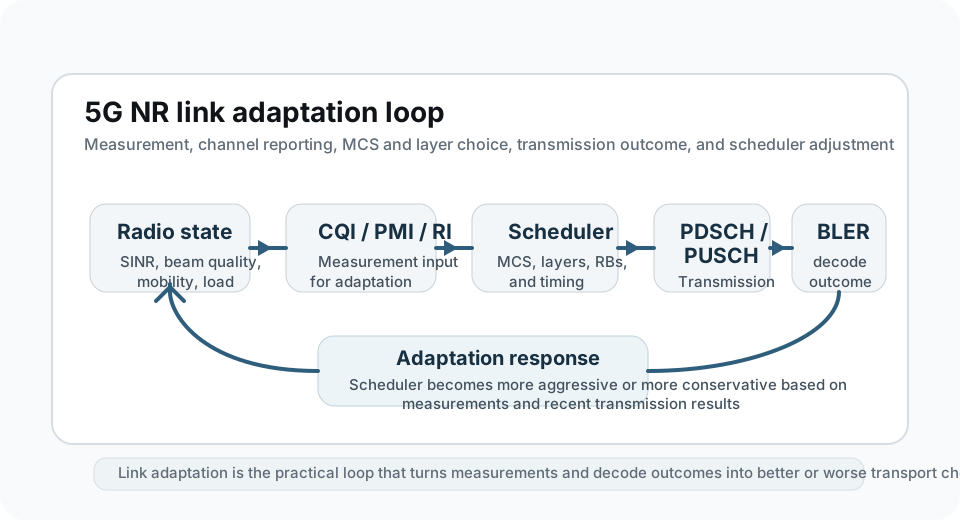
Engineers should read link adaptation as a closed control loop. The network observes channel quality, receives measurement-related input, chooses a transport profile, observes how that decision performs, and then adjusts again.
Measurements come first
The scheduler needs some view of current radio conditions. On the downlink side, this often relates to CSI reporting built from signals such as CSI-RS. On the uplink side, observation and sounding such as SRS help the network understand how far it can push the UE.
CQI, PMI, and RI help shape the decision
CQI gives an indication of usable channel quality. PMI relates to preferred precoding behavior. RI reflects the likely rank or layer situation. Engineers should not treat them as magic values; they are decision inputs that still need to match real radio conditions.
MCS is the practical expression of adaptation
In many troubleshooting sessions, link adaptation is most visible through MCS movement. When the radio looks strong, MCS can move upward. When the channel becomes uncertain, MCS should step down to protect decode success.
HARQ reveals whether adaptation is working
Good adaptation usually produces healthy throughput without excessive retransmissions. If HARQ pressure rises, it often means the transport choices are too optimistic for the real channel.
Measurements -> CQI / PMI / RI input -> scheduler picks MCS and layers -> transmission result -> adaptation updateInputs and outputs engineers should watch
| Input or output | Why it matters in practice |
|---|---|
| CQI | Shows how healthy the reported channel looks from a transport-efficiency perspective |
| PMI | Helps the network choose a suitable precoding-related transmission strategy |
| RI | Indicates how many layers may be reasonable in the current channel state |
| MCS | The most visible expression of adaptation in logs and scheduler views |
| BLER / HARQ | Shows whether the chosen transmission profile was realistic for the actual channel |
| Throughput | Final user-facing result of whether the adaptation loop is working well |
Adaptive behavior engineers commonly see
| Pattern | Interpretation |
|---|---|
| High CQI with stable MCS | Usually healthy radio conditions with room for efficient transport |
| Rapid MCS fluctuation | Often linked to unstable radio quality, mobility, interference, or beam changes |
| Low CQI with repeated HARQ | Adaptation may still be too aggressive, or the cell may be under real radio stress |
| Persistently low MCS without obvious radio failure | May indicate conservative adaptation, poor reporting fidelity, or scheduler policy limits |
Where link adaptation matters in real procedures
Link adaptation is not a single stand-alone call-flow message. It is an operating behavior that becomes visible once the UE and network are exchanging real scheduled traffic and measurement information.
- It shapes downlink efficiency on PDSCH.
- It shapes uplink efficiency on PUSCH.
- It relies on measurement quality from CSI-RS and SRS.
- It is exposed through retransmission behavior described on the HARQ page.
- It becomes especially visible during throughput analysis, mobility instability, and radio troubleshooting.
Mini sequence flow
CSI / channel observation
   -> CQI / PMI / RI context
   -> scheduler selects MCS and layers
   -> PDSCH / PUSCH transmission
   -> throughput and HARQ outcome drive later adjustment
Real-world engineering examples
A user can have acceptable coverage but poor throughput if adaptation is too conservative. In that case, decode success may look fine, but the network is leaving performance on the table through low MCS and low layer use.
The opposite case is also common: the scheduler pushes too aggressively, the radio cannot sustain the chosen profile, and throughput falls because retransmissions eat the gain.
What to check in logs, KPIs, and traces
- CQI trends and whether they make sense for the observed radio quality
- MCS movement over time, not just a single snapshot
- Layer or rank behavior where available
- HARQ retransmission levels and BLER outcomes
- CSI-RS and SRS health if reporting or uplink understanding looks weak
- Beam instability, mobility events, and interference spikes
- Gap between scheduled resources and actual usable throughput
| Symptom | Likely engineering direction |
|---|---|
| Low throughput with okay coverage | Check whether MCS and layer use are too conservative for the real channel |
| High retransmission pressure | Check whether adaptation is too aggressive for the actual radio state |
| MCS jumps up and down rapidly | Check mobility, beam transitions, interference variation, and unstable reporting |
| Good CQI but poor real throughput | Check whether reporting is stale, rank use is limited, or scheduler policy is restricting transport |
Common mistakes engineers make with link adaptation
- Looking only at CQI without checking whether HARQ and BLER agree with the reported quality.
- Assuming high MCS always means good performance, even when retransmissions are heavy.
- Treating downlink and uplink adaptation as identical problems.
- Ignoring beam and mobility behavior when adaptation looks unstable.
Beginner takeaway
Link adaptation is how 5G NR tries to use the radio link efficiently without becoming reckless. It is the bridge between measurements, scheduler decisions, and the throughput users actually see.
Advanced engineer notes
- Good adaptation is a system-level behavior, not just a CQI number.
- Scheduler policy, reporting freshness, beam stability, and HARQ pressure all influence the real outcome.
- Persistent mismatch between CQI and usable throughput often points to a deeper reporting, beam, or interference problem.
- In field work, adaptation quality is usually judged by patterns over time rather than a single counter snapshot.
FAQ
What is link adaptation in 5G?
It is the process of adjusting transmission aggressiveness based on radio conditions and observed performance.
What do CQI, PMI, and RI mean?
They are measurement-related inputs that help the scheduler decide how to transmit, especially on the downlink.
Is link adaptation the same as AMC in 5G?
In practical engineering discussion, AMC is often part of the same adaptation idea: the system adjusts transport choices based on channel quality.
Why does bad link adaptation hurt throughput?
If it is too conservative, the network wastes capacity. If it is too aggressive, decode failures and HARQ retransmissions increase.
Use the calculator and related tools
Link adaptation becomes much easier to interpret when you compare scheduler choices with actual transport expectations. Use the NR Throughput Calculator to test MCS and layer assumptions, then move into the 3GPP Decoder to connect procedure traces and message context with the radio behavior underneath them.