5G Random Access Procedure - 5G NR Initial Access Explained
The 5G random access procedure is the radio entry process that takes the UE from cell discovery into usable network access. In practical terms, 5G NR initial access starts with discovery and early broadcast handling, moves through the random access exchange, and then progresses into the early setup path.
For beginners, this page explains how the UE gets into the network at the radio level. For experienced engineers, it connects SSB, PBCH, PRACH, access response, MSG1 MSG2 MSG3 MSG4, and 2-step / 4-step RACH into one troubleshooting-friendly view.
| Primary concept | UE radio entry path from discovery to usable setup progression |
|---|---|
| Main specs | 3GPP TS 38.211, 38.213, 38.321, 38.331 |
| Core keywords | 5G random access procedure, initial access, 4-step RACH, 2-step RACH, MSG1 MSG2 MSG3 MSG4 |
| Why it matters | If initial access is unstable, registration, setup, mobility, and service reliability often fail before deeper signaling can even begin |
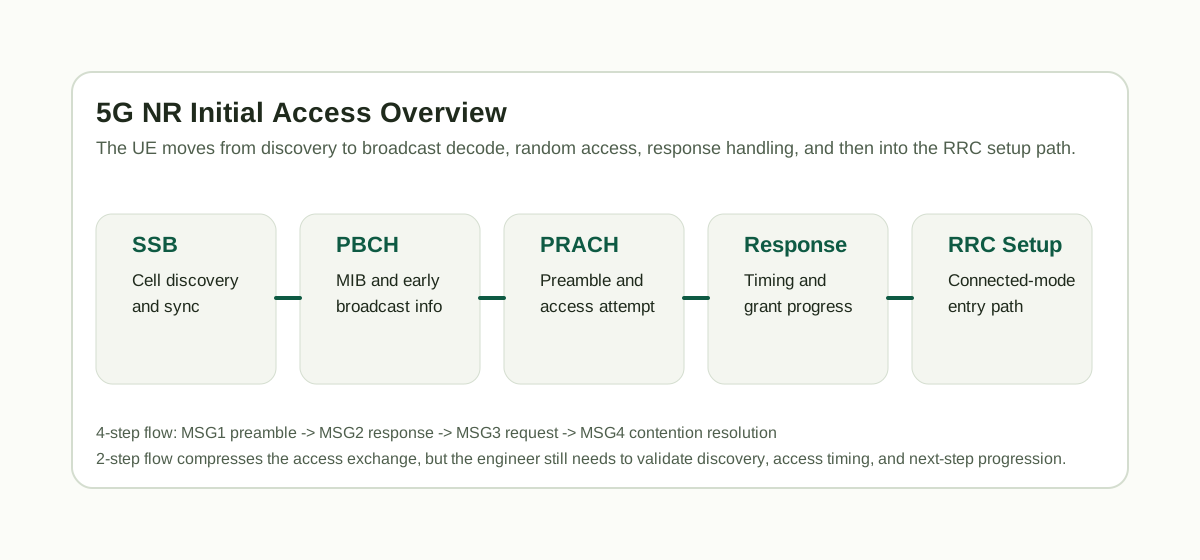
What 5G initial access means in simple terms
In simple terms, the UE cannot just start talking to the network immediately. It must first find the cell, learn the early radio context, request access, receive a response, and then move into the next setup stage.
- The UE first discovers the cell and synchronization path.
- It then decodes the early broadcast information it needs.
- After that, it begins the random access exchange.
- If that exchange works, the UE can continue into RRC setup and later NAS signaling.
That is why engineers should treat initial access as a full chain rather than just “PRACH success” or “RRC setup failure” in isolation.
Technical summary
| Procedure name | 5G NR initial access / 5G random access procedure |
|---|---|
| Main entry signals | SSB, PBCH, PRACH |
| Common 4-step view | MSG1 preamble, MSG2 response, MSG3 follow-up request, MSG4 contention resolution |
| Main engineering concerns | Discovery reliability, beam visibility, PBCH decode, PRACH timing, access response, retries, later setup progression |
| What it influences | Registration, service request entry, mobility re-entry, and the success of later signaling procedures |
How the 5G random access procedure works
Engineers should read initial access as a staged radio-entry workflow. Each stage depends on the previous one being good enough to let the UE continue.
Step 1: Cell discovery and synchronization
The UE first uses the SSB path to detect the cell and synchronize to it. If this step is weak, everything that comes later will look unstable or absent.
Step 2: Early broadcast decode
The UE then uses PBCH to acquire the early broadcast information needed to move deeper into the access path.
Step 3: Random access exchange
The UE enters the PRACH phase and starts the random access exchange. In the common 4-step explanation, this is where engineers talk about MSG1 to MSG4.
Step 4: Progression toward setup
If the access exchange succeeds, the UE can move into the later setup path, typically visible in the 5G RRC Connection Setup procedure.
SSB -> PBCH -> PRACH / MSG1 -> MSG2 -> MSG3 -> MSG4 -> RRC Setup path| Stage | What engineers should know |
|---|---|
| SSB | The UE must first discover and synchronize to the cell in a stable way |
| PBCH | The UE needs usable early broadcast information before clean access progression can continue |
| PRACH / MSG1 | The UE sends the access preamble in the configured access opportunity |
| MSG2 | The network response tells the UE whether access progression is continuing correctly |
| MSG3 / MSG4 | The later part of the exchange confirms the access path and resolves contention in the familiar 4-step view |
4-step RACH, 2-step RACH, and other initial-access variants
Engineers usually compare initial access by the procedure structure. The most familiar view is 4-step RACH, but NR also supports 2-step RACH and different access-control modes.
| Variant | What engineers should know |
|---|---|
| 4-step RACH | The familiar staged access view with MSG1, MSG2, MSG3, and MSG4 spread across a longer exchange |
| 2-step RACH | A more compact access structure that reduces procedure length when the deployment and configuration support it |
| MSG1 | The preamble transmission that starts the 4-step access exchange |
| MSG2 | The response stage that tells the UE whether the access path is continuing correctly |
| MSG3 | The follow-up request stage used after the initial response in the 4-step view |
| MSG4 | The contention-resolution stage that confirms usable access progression in the 4-step view |
| Contention-based access | The UE competes for access resources, so collision and retry behavior become important troubleshooting clues |
| Contention-free access | The network guides the UE through a more controlled access path where contention risk is reduced |
Where initial access appears in real workflows
First entry into the cell
Cell found -> early information -> random access -> setup progression -> registration pathThis is the most obvious initial-access use case. The UE needs the whole radio-entry path to work before registration and service use can continue.
Return to service after losing usable context
The UE may re-enter a similar access path when it needs to recover from lost context or regain a usable connected path after interruption.
Coverage and beam-sensitive entry
In real field troubleshooting, initial access often behaves differently across locations because discovery, beam visibility, broadcast decode, and preamble detection are all coverage-sensitive.
Real-world engineering examples
Example 1: The UE sees the cell but never registers
This often means the discovery path is only partially healthy. The UE may see the cell, but PBCH decode, PRACH timing, or the access-response stage may still be failing.
Example 2: Access works near the site but not at the edge
That often points to a coverage or beam-sensitive initial-access problem rather than a higher-layer logic issue.
Example 3: Repeated access retries with no clean setup progression
In those cases, engineers should inspect the whole chain from SSB to MSG2 or later, not only the final RRC or NAS symptom that appears in the trace.
What to check when 5G initial access fails
- whether SSB discovery is present and stable
- whether PBCH decode succeeds after discovery
- whether the PRACH attempt happens in the expected access opportunity
- whether MSG2 or the next expected response stage appears
- whether retries, backoff, or repeated access attempts are visible
- whether coverage, beam, or uplink margin is blocking progress at the access stage
- whether the procedure reaches the RRC setup path after the access exchange
| Symptom | What to inspect first |
|---|---|
| Cell visible but no usable access | Check SSB stability, PBCH decode, and whether PRACH actually starts |
| PRACH attempts but no clean progress | Check access-response presence, timing behavior, and whether the exchange is stopping after MSG1 or MSG2 |
| Repeated random access retries | Check beam, coverage, contention behavior, and whether the access path is colliding or failing to progress |
| RRC setup missing after access | Check whether the problem is really after access or whether the earlier access chain was never completed correctly |
Common mistakes engineers make with initial access
- treating initial access as only a PRACH topic instead of a full chain from discovery to setup
- jumping directly to NAS or RRC failure analysis before checking SSB and PBCH readiness
- assuming MSG1 presence automatically means the access procedure is progressing correctly
- ignoring contention and retry behavior in repeated access failures
- forgetting that field-location differences often show up in the access chain first
Beginner takeaway
The 5G random access procedure is the radio entry path that gets the UE into the network. It starts with discovery, continues through the access exchange, and then leads into the later setup and signaling path.
Advanced engineer notes
- Initial access problems often hide behind later RRC or NAS symptoms, but the real failure starts earlier in the chain.
- 2-step and 4-step RACH should be compared as operational designs, not only as textbook diagrams.
- Access troubleshooting is strongest when SSB, PBCH, PRACH, access response, and setup progression are correlated in one trace view.
- Coverage, beam alignment, and uplink margin often explain access instability better than later-layer message names do.
FAQ
What is the 5G random access procedure?
It is the radio entry procedure that moves the UE from discovery into usable network access and later setup progression.
What is the difference between 4-step and 2-step RACH in 5G?
4-step RACH uses the familiar MSG1 to MSG4 exchange, while 2-step RACH compresses the access structure to make the procedure shorter in the right deployment conditions.
What are MSG1, MSG2, MSG3, and MSG4?
In the common 4-step view, they represent the preamble, response, follow-up request, and contention-resolution stages of the access exchange.
Why can the UE see the cell but still fail initial access?
Because discovery, PBCH decode, random access, and later setup are different parts of the chain. One can work while another still fails.
What should I inspect first when initial access is unstable?
Start with SSB, PBCH, PRACH timing, access response, retries, and whether the procedure reaches the setup stage after the access exchange.
Is initial access only relevant during first registration?
No. Similar access behavior can matter again when the UE needs to re-enter a usable radio path after losing or re-establishing context.
Use the decoder and call flow naturally in this workflow
Pair this page with the 3GPP Decoder and the 5G RRC Connection Setup call flow when you want to trace how the random access exchange leads into later signaling and service procedures.