5G NR DMRS - Demodulation Reference Signal
The 5G NR DMRS, or Demodulation Reference Signal, is the reference signal the receiver uses to estimate the radio channel so that scheduled data can be demodulated and decoded correctly. In practical terms, DMRS is one of the key reasons a PDSCH or PUSCH transmission can be decoded reliably instead of looking like unusable radio energy.
For beginners, DMRS is the signal that helps the receiver “understand the channel” before trying to decode data. For experienced engineers, it is where mapping behavior, density, overhead, BLER, MCS limits, and decoding quality come together in real troubleshooting work.
| Full name | Demodulation Reference Signal |
|---|---|
| Main specs | 3GPP TS 38.211, 38.212, 38.214 |
| Main concepts | Channel estimation, resource mapping, PDSCH DMRS, PUSCH DMRS, overhead, decoding support |
| Why it matters | DMRS helps the receiver estimate the channel correctly so scheduled data can be decoded with acceptable reliability |
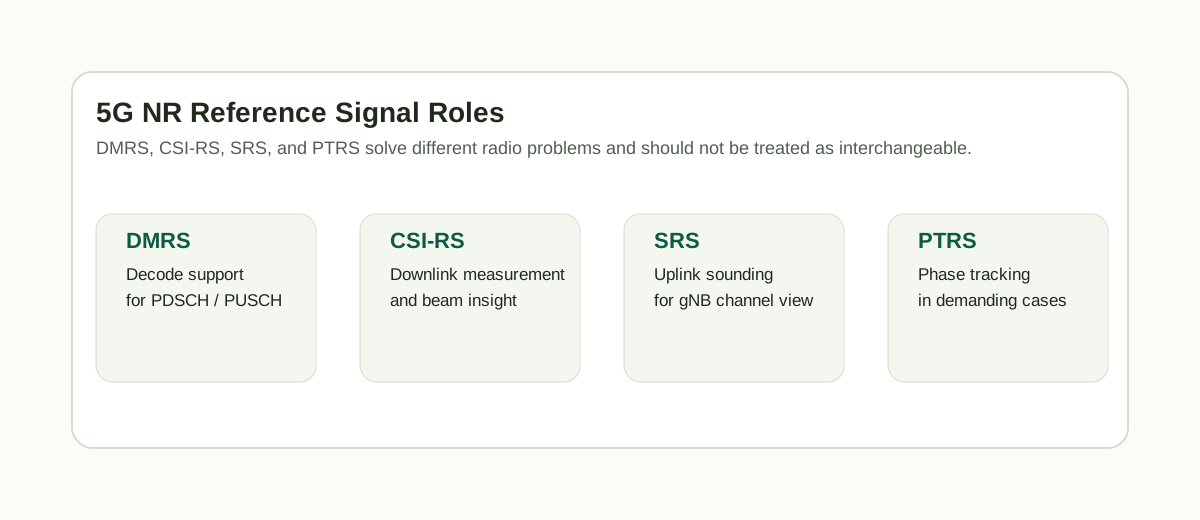
What DMRS means in simple terms
In practical engineering language, DMRS is the reference pattern that helps the receiver figure out how the channel has affected a transmission. Without that help, decoding the scheduled data would be much less reliable.
- DMRS supports channel estimation for data decoding.
- It is closely tied to scheduled transmissions like PDSCH and PUSCH.
- It improves decode reliability but also consumes some resource elements.
- Engineers inspect DMRS when data decode quality and BLER do not match expectations.
Technical summary
| Role | Reference-signal support for demodulation and channel estimation |
|---|---|
| Main channels supported | PDSCH and PUSCH in the most common engineering discussions |
| Main engineering inputs | Mapping type, density, symbol placement, transmission length, MIMO and scheduler assumptions |
| Main engineering outputs | Decode reliability, BLER behavior, usable payload efficiency, and practical throughput stability |
| Linked topics | PDSCH, PUSCH, OFDM, MIMO, throughput analysis, BLER troubleshooting |
How DMRS works in practice
Engineers should read DMRS as a decode-support signal. The receiver uses it to understand the effective channel seen by the scheduled transmission so that it can demodulate the payload more accurately.
Channel estimation support
Radio propagation changes amplitude, phase, and perceived signal quality. DMRS gives the receiver known reference points so it can estimate those changes and compensate during decoding.
DMRS on PDSCH and PUSCH
Engineers most often inspect DMRS in downlink and uplink shared-channel analysis. If the signal-estimation path is weak, the scheduled data may fail even when the resource assignment itself looks correct.
Overhead tradeoff
DMRS improves decode robustness, but the resource elements used for DMRS are not available for raw payload. That is why DMRS design affects both reliability and net throughput.
| Concept | What it means in practice |
|---|---|
| Channel estimation | The receiver’s attempt to understand how the radio channel changed the transmission |
| DMRS placement | The specific resource elements and symbols reserved for reference support |
| Decode reliability | How well the receiver can recover the data once it uses the reference signal properly |
| Overhead | The portion of the scheduled resources consumed by reference support instead of payload |
| Scheduler tradeoff | The balance between stronger decode support and reduced net payload efficiency |
DMRS formats and operational variants
DMRS is most useful to compare through its mapping and density variants. Those variants change how robust the decode path is and how much overhead the scheduled transmission must carry.
| Variant | What engineers should know |
|---|---|
| PDSCH DMRS | Supports downlink shared-channel decoding and should be read together with downlink RBs, symbols, and layers |
| PUSCH DMRS | Supports uplink shared-channel decoding and should be read together with uplink grant, power, and gNB decode quality |
| Mapping Type A | Often tied to slot-oriented behavior where regular symbol placement supports standard scheduled transmissions |
| Mapping Type B | Useful when the scheduled transmission uses a more flexible symbol start or shorter-duration allocation pattern |
| Lower DMRS density | Improves payload efficiency but can reduce robustness if channel conditions are demanding |
| Higher DMRS density | Improves estimation robustness at the cost of more overhead and lower net payload efficiency |
Where DMRS appears in real procedures
Downlink data decode path
PDCCH assignment -> PDSCH with DMRS -> channel estimation -> data decode -> HARQ resultThis is the most familiar DMRS workflow. The control assignment may be correct, but if the DMRS-supported channel estimation is weak, the downlink decode result can still fail.
Uplink shared-channel decode path
Uplink grant -> PUSCH with DMRS -> gNB channel estimation -> uplink decode resultIn uplink work, engineers use DMRS to understand why the gNB did or did not decode the UE transmission cleanly.
Throughput and BLER interpretation
DMRS is also part of the payload-efficiency story because more reference support can improve decode robustness while reducing usable payload space.
Real-world engineering examples
Example 1: Why good scheduling still produces poor decode quality
The RB and symbol allocation may look fine, but if the signal-estimation path is weak, the receiver may still struggle to decode the transport block successfully.
Example 2: Why throughput is lower than expected
Throughput can be lower because some of the scheduled resources are consumed by DMRS overhead, not only because the MCS or RB count is lower than expected.
Example 3: Why uplink decode stability differs from downlink decode stability
The uplink decode path depends on different radio conditions and power behavior, so PUSCH DMRS analysis can reveal issues that do not look the same in the downlink.
What to check in logs, counters, and traces
- whether the relevant shared-channel transmission has the expected DMRS mapping behavior
- DMRS density and whether it looks too light or too heavy for the radio conditions
- BLER, decode success, and retransmission patterns
- MCS aggressiveness compared with the practical channel-estimation quality
- payload-efficiency loss caused by DMRS overhead
- whether downlink and uplink decode behavior differ because the signal-estimation path differs
- whether the issue is really DMRS-related or started earlier in control, timing, or BWP interpretation
| Symptom | What to inspect first |
|---|---|
| High BLER on scheduled data | Whether DMRS placement and density match the radio conditions and scheduling assumptions |
| Lower throughput than expected | Whether DMRS overhead is consuming more usable payload space than the estimate assumed |
| Downlink assignment present but decode weak | Whether the PDSCH DMRS-supported estimation path looks robust enough |
| Uplink grant present but gNB decode weak | Whether the PUSCH DMRS-supported estimation path and uplink radio quality look healthy |
Common mistakes engineers make with DMRS
- treating DMRS as a spec detail instead of a practical decode-quality factor
- ignoring the payload overhead introduced by reference support
- assuming that a correct grant automatically means decoding should work
- looking at BLER without checking whether the signal-estimation path is robust enough
- assuming uplink and downlink DMRS issues always look identical in practice
Beginner takeaway
DMRS is the reference signal that helps the receiver decode scheduled data correctly. Without it, the receiver would have a much harder time understanding how the radio channel changed the transmission.
Advanced engineer notes
- DMRS design is a tradeoff between stronger channel estimation and lower net payload efficiency.
- High BLER does not always mean the grant is wrong; it can mean the estimation path is not robust enough for the chosen transmission setup.
- Mapping type and density decisions should be interpreted together with the actual time-domain scheduling structure.
- Engineers should compare PDSCH DMRS and PUSCH DMRS behavior separately because the surrounding radio conditions differ.
FAQ
What does DMRS do in 5G NR?
DMRS helps the receiver estimate the channel so it can demodulate and decode scheduled data correctly.
Is DMRS used for both downlink and uplink?
Yes. Engineers commonly analyze DMRS in both PDSCH and PUSCH contexts.
Why can DMRS affect throughput?
Because the reference support improves decode robustness but also consumes resource elements that cannot carry raw payload.
What should I inspect first when decode quality is weak?
Start with DMRS mapping behavior, density, BLER trends, and whether the signal-estimation support is strong enough for the radio conditions and chosen MCS.
What is the difference between Mapping Type A and Mapping Type B?
They represent different practical mapping behaviors, with one more aligned to regular slot-style scheduling and the other more useful when scheduling needs greater timing flexibility.
Why might uplink and downlink DMRS issues look different?
Because the surrounding channel conditions, power behavior, and decode environment differ between the UE and the gNB sides of the link.
Use the tools naturally in this workflow
Pair this page with the NR Throughput Calculator when you want to compare payload expectations against DMRS overhead, and read it together with PDSCH and PUSCH when you are troubleshooting decode quality.