5G NR CSI-RS - Channel State Information Reference Signal
The 5G NR CSI-RS, or Channel State Information Reference Signal, is a reference signal used to help the UE and network build a useful view of channel conditions for measurement, reporting, and adaptation. In practical engineering work, CSI-RS is one of the key signals behind beam-related decisions and channel-quality awareness.
For beginners, CSI-RS is the signal used to understand how the radio channel looks for later decisions. For experienced engineers, it is where beam quality, measurement design, reporting consistency, and performance adaptation become visible in real deployment behavior.
| Full name | Channel State Information Reference Signal |
|---|---|
| Main specs | 3GPP TS 38.211, 38.214, 38.331 |
| Main concepts | Measurement signal, CSI reporting, beam management, channel quality, resource configuration |
| Why it matters | CSI-RS helps the network and UE build a usable channel-quality and beam-quality picture that supports adaptation and performance decisions |
What CSI-RS means in simple terms
In practical engineering terms, CSI-RS is a measurement-focused reference signal. Instead of mainly helping a receiver decode one specific scheduled transport block, it helps build a broader channel-quality picture that can be used for later reporting and optimization.
- CSI-RS supports channel-state and beam-related measurement.
- It helps the system make better radio adaptation decisions.
- It is commonly tied to measurement reporting and beam management workflows.
- Engineers inspect CSI-RS when adaptation, beam quality, or measurement behavior looks wrong.
Technical summary
| Role | Measurement and channel-state reference signal |
|---|---|
| Main practical use | Support for CSI reporting, beam-related observation, and channel-quality adaptation |
| Main engineering inputs | Resource configuration, periodicity, beam behavior, measurement purpose, reporting setup |
| Main engineering outputs | Usable channel-quality view, beam differentiation, better adaptation inputs, measurement consistency |
| Linked topics | Beamforming, CSI feedback, PDSCH efficiency, mobility measurements, radio optimization |
How CSI-RS works in practice
Engineers should read CSI-RS as a measurement and adaptation signal. It gives the radio system a way to observe channel quality and beam behavior beyond the immediate decode problem of one scheduled data event.
Channel-state measurement support
CSI-RS helps create a view of channel quality that can feed later reporting and adaptation. This is why it is often discussed together with CQI, PMI, RI, and beam selection workflows.
Beam-management context
In practical NR deployments, CSI-RS is often a beam-management topic as much as a measurement topic. Engineers use it to understand which directional resources are looking strong, weak, stable, or unstable.
Resource and periodicity behavior
CSI-RS is only useful if the right resources are configured and the measurement opportunities are available at the expected times. This is why periodicity and configuration matter so much in troubleshooting.
| Concept | What it means in practice |
|---|---|
| Channel-state view | The practical measurement picture used to support later adaptation and optimization |
| Beam visibility | The ability to differentiate directional radio behavior across beam candidates or beam states |
| Reporting support | The signal basis behind CSI-related reports used in later scheduling and beam decisions |
| Resource configuration | The configured timing and mapping behavior that makes CSI-RS measurement possible |
| Measurement consistency | Whether the observed signal behavior is stable and useful enough for reliable adaptation decisions |
CSI-RS formats and operational variants
CSI-RS is most useful to compare by its resource and usage variants. In practical work, engineers usually care more about why the signal was configured and how often it appears than about memorizing a raw signal definition.
| Variant | What engineers should know |
|---|---|
| Periodic CSI-RS | Regular measurement opportunities that support steady channel observation over time |
| Semi-persistent CSI-RS | Measurement behavior that is more structured than one-shot use but more selective than always-periodic behavior |
| Aperiodic CSI-RS | On-demand style measurement behavior used when the network wants targeted observation rather than a constant pattern |
| Beam-management oriented CSI-RS | Used when directional comparison and beam-quality tracking are the main practical focus |
| Channel-quality reporting oriented CSI-RS | Used when the main goal is supporting CSI feedback for later scheduling and adaptation |
| Lower-density measurement view | Less overhead, but potentially less robust or less granular measurement detail |
| Higher-density measurement view | Richer observation quality at the cost of more measurement overhead and resource consumption |
Where CSI-RS appears in real procedures
Channel measurement and reporting path
CSI-RS transmission -> UE measurement -> CSI-related report -> adaptation / scheduling decisionThis is the most common CSI-RS workflow. The signal is transmitted, measured, and then converted into inputs used by later adaptation logic.
Beam-management workflow
CSI-RS on candidate beams -> beam quality observation -> beam-related decision -> later performance outcomeIn beam-based deployments, CSI-RS is often part of the directional quality picture engineers inspect when coverage and performance vary strongly across beams.
Throughput and adaptation interpretation
CSI-RS does not directly carry payload, but it can still shape throughput indirectly because better channel and beam knowledge supports better scheduling and adaptation decisions later.
Real-world engineering examples
Example 1: Why beam behavior looks unstable
If CSI-RS-based observation is weak, irregular, or misaligned with actual beam conditions, the resulting beam decisions can look inconsistent from the engineer’s point of view.
Example 2: Why adaptation quality looks poor
Even if the scheduler and channels are otherwise healthy, weak CSI-RS measurement quality can produce poor input for later CQI, PMI, rank, or beam-related decisions.
Example 3: Why performance differs across locations
CSI-RS can reveal that one area of the cell has a much better directional or channel-quality picture than another, even before the engineer looks deeply at user-plane performance.
What to check in logs, counters, and traces
- whether CSI-RS resources are configured and present as expected
- whether the timing periodicity matches the intended measurement behavior
- beam visibility and whether CSI-RS is showing usable directional differences
- whether CSI-related reporting appears consistent with observed radio conditions
- whether poor adaptation may really start from weak CSI-RS observation quality
- whether measurement overhead and resource design match the optimization goal
- whether CSI-RS issues are being confused with DMRS or data-channel decode issues
| Symptom | What to inspect first |
|---|---|
| Unstable beam behavior | Whether CSI-RS measurement opportunities and beam visibility look consistent |
| Poor adaptation decisions | Whether CSI-RS-based observation is giving a useful channel-quality picture |
| Reporting looks inconsistent | Whether CSI-RS configuration, periodicity, and beam context match the expected reporting setup |
| Good decode quality but weak optimization outcome | Whether the problem is in the measurement and adaptation path rather than the data-decode path |
Common mistakes engineers make with CSI-RS
- treating CSI-RS like a decode-support signal instead of a measurement and adaptation signal
- mixing up CSI-RS problems with DMRS problems during troubleshooting
- ignoring beam context when analyzing CSI-RS behavior
- focusing only on raw signal presence instead of whether the resulting reporting and adaptation are actually useful
- forgetting that measurement timing and periodicity can be the root cause of unstable behavior
Beginner takeaway
CSI-RS is the measurement-oriented reference signal in 5G NR. It helps the network and UE build a useful picture of channel and beam quality so later decisions can work better.
Advanced engineer notes
- CSI-RS problems often show up indirectly through weak adaptation or unstable beam decisions rather than through obvious decode failure.
- Engineers should separate CSI-RS analysis from DMRS analysis even though both are reference-signal topics.
- Measurement usefulness depends not only on signal existence but also on how well the configured periodicity and resources fit the deployment goal.
- In beam-based deployments, CSI-RS can be one of the clearest windows into directional performance behavior.
FAQ
What does CSI-RS do in 5G NR?
CSI-RS supports channel-state and beam-related measurement so the system can make better reporting and adaptation decisions.
How is CSI-RS different from DMRS?
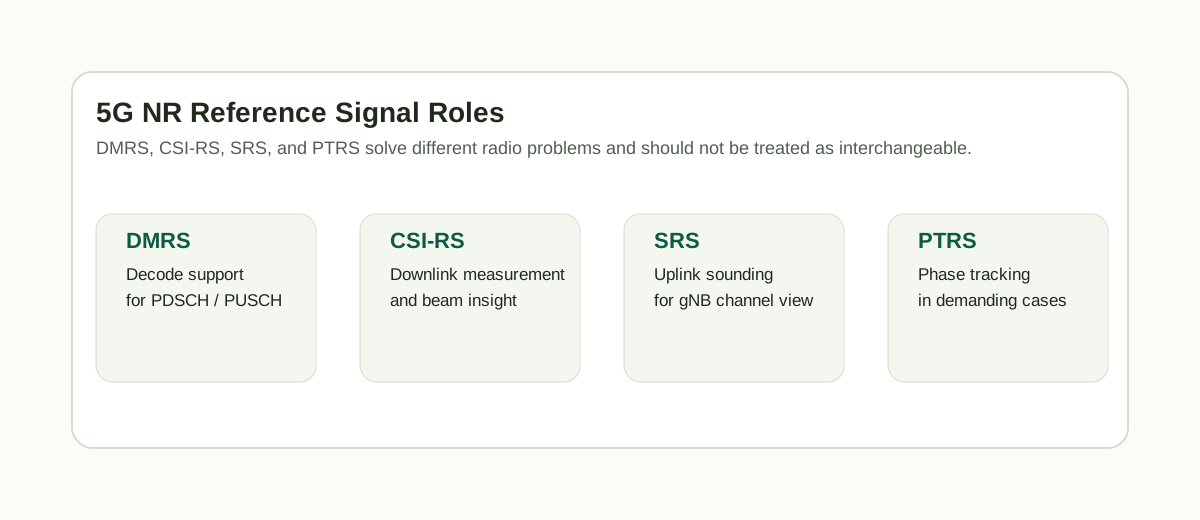
CSI-RS is mainly for measurement and adaptation, while DMRS is mainly for direct demodulation and decoding support on scheduled data transmissions.
Why is CSI-RS important for beam management?
Because it helps the system observe directional signal quality and compare beam-related behavior in practical deployments.
What should I inspect first when CSI-related behavior looks unstable?
Start with CSI-RS configuration, periodicity, beam visibility, and whether the resulting reports look consistent with actual radio conditions.
Can CSI-RS affect throughput indirectly?
Yes. Better channel-state and beam-quality knowledge can improve later scheduling and adaptation, which can improve practical performance.
Is CSI-RS a user-data channel?
No. CSI-RS is a reference signal used for observation and adaptation, not a payload-bearing data channel.
Use the related PHY pages naturally in this workflow
Pair this page with SSB and Beamforming when you are looking at directional behavior, and read it together with PDSCH when you want to see how measurement quality later affects practical throughput.