5G Coverage Issues Troubleshooting - NR Coverage and Radio Checks
5G coverage issues usually start showing up before throughput becomes the main complaint. The UE may struggle to detect a cell cleanly, see unstable SSB visibility, fail access at the edge, or show weak RSRP and poor SINR even where a serving cell technically exists.
For beginners, this page is the radio-side workflow for “why is 5G coverage weak or unstable?” For experienced engineers, it is the practical path for separating propagation limits, beamforming limits, interference, and access-side instability before treating the issue as a generic mobility or service problem.
| Primary keyword | 5G coverage issues |
|---|---|
| Main focus | Radio-side coverage loss, weak cell reach, and unstable edge behavior in NR |
| Most useful checks | SSB visibility, RSRP, SINR, beam quality, access stability, and band / carrier context |
| Best paired pages | SSB, beamforming, initial access, ARFCN, and link budget tools |
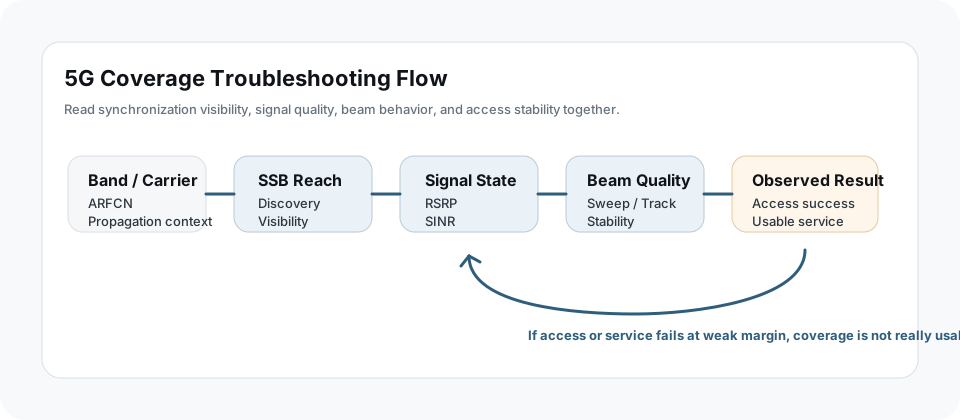
What a 5G coverage issue means in simple terms
In practical language, a coverage issue means the UE is too close to the edge of what the radio can deliver reliably. Sometimes the problem is weak signal strength, but just as often it is poor beam visibility, low SINR, blocked propagation, or access instability even though the UE still sees some signal.
- Coverage is not only about whether the UE sees a cell.
- A cell can be visible but still not offer stable, usable service.
- SSB detection and access success are often the first warning signs.
- RSRP alone is not enough; SINR, beam quality, and link margin matter too.
Fast triage before deeper troubleshooting
| Question | Why it matters |
|---|---|
| Can the UE detect SSB reliably? | If SSB visibility is weak or unstable, the problem starts before steady service even begins. |
| Is the issue weak signal, poor quality, or both? | This separates pure reach problems from interference or beam-quality problems. |
| Does initial access succeed consistently? | Coverage problems often show up as unstable or repeated access attempts at the edge. |
| Is the issue location-specific, orientation-specific, or movement-specific? | That often points to blockage, beam behavior, or local propagation shadowing. |
| Does the band or carrier choice match the intended coverage objective? | Propagation expectations vary strongly across bands and can explain unrealistic coverage assumptions. |
Common radio-side coverage root causes
Weak SSB visibility
If SSB is not visible enough, the UE may struggle with discovery, synchronization, or stable camping. This is one of the clearest early indicators of a coverage problem.
Beamforming limitations
Coverage in NR is often beam-shaped rather than uniformly spread. Poor beamforming, beam mismatch, or unstable beam tracking can create pockets of weak or inconsistent service even within nominal cell range.
Low RSRP
Low RSRP is the classic weak-signal condition. It points to limited link margin, long distance, blockage, or a band choice that is less favorable for the environment.
Poor SINR despite acceptable signal strength
A UE may see the cell but still perform poorly because interference or noisy radio conditions destroy quality. This is why a “coverage problem” is sometimes really a quality problem.
Band and carrier mismatch to the scenario
Some observed coverage issues are not faults at all; they are unrealistic expectations for the chosen band, carrier, and deployment geometry. The ARFCN and band context matters.
Band / carrier -> SSB visibility -> RSRP / SINR -> beam stability -> access success -> usable coverageHow coverage problems usually show up in practice
| Observed symptom | Most likely radio interpretation |
|---|---|
| UE sees the cell only intermittently | SSB reach, beam coverage, or blockage is likely unstable. |
| Good signal at one angle, poor at another | Beam directionality, blockage, or polarization / orientation effects are likely involved. |
| Reasonable RSRP but service still weak | SINR, interference, or access-side instability is likely the real limiter. |
| Coverage loss near indoor boundaries or partial obstruction | Propagation loss and beam blockage are likely dominating. |
| Coverage fails mainly at access or camp-on stage | Initial synchronization, PBCH reading, or random access may be failing at weak margin. |
What to check in logs, traces, and KPIs
- SSB visibility and whether the UE sees the expected beam or cell consistently
- RSRP and SINR together, not one without the other
- beam stability if the issue changes with movement, orientation, or blockage
- initial access success rate and whether PRACH attempts rise near the edge
- PBCH or system-information reliability when the UE sees the cell but cannot proceed cleanly
- band and carrier choice, especially if the coverage expectation looks unrealistic for the deployment
- link budget margin using RF tools when the issue feels propagation-driven
Common failure patterns and what they usually mean
SSB visible only in short bursts
This often means beam coverage is marginal or unstable. The UE is seeing a usable beam only intermittently.
Low RSRP everywhere in one area
This points more toward path loss, blockage, or basic link margin shortage than toward scheduler or transport issues.
Reasonable RSRP but poor SINR
The cell is present, but quality is weak. Interference or poor beam separation is usually the bigger issue than raw reach.
Access failures only at cell edge
Weak synchronization, unstable PBCH decode, or marginal PRACH performance is likely causing the user-visible coverage complaint.
Engineer workflow for 5G coverage troubleshooting
- Confirm whether the UE can consistently detect the serving SSB.
- Check RSRP and SINR together to separate weak reach from poor quality.
- Correlate beam behavior when the issue changes with motion or device orientation.
- Validate whether initial access succeeds reliably at the affected location.
- Check band, carrier, and ARFCN context before assuming the coverage target is realistic.
- Use link budget tools when the issue looks propagation-driven rather than signaling-driven.
Beginner takeaway
5G coverage problems are not only about weak bars. Start with SSB visibility, signal strength, signal quality, beam stability, and access success, and the real bottleneck becomes much clearer.
Advanced engineer notes
- Coverage complaints often mix reach and quality, so RSRP without SINR usually leads to incomplete diagnosis.
- At higher frequencies, beam and blockage behavior can dominate the coverage experience more than raw distance alone.
- Access-side failure at weak margin is often the most useful practical definition of a true coverage problem.
- Band selection and carrier placement should always be checked before labeling a coverage gap as a network defect.
FAQ
How do I troubleshoot 5G coverage issues?
Start with SSB visibility, RSRP, SINR, beam quality, and access success before moving to later-layer explanations.
Why is 5G coverage poor even near a site?
Beam behavior, blockage, interference, or band choice can all weaken usable coverage even when a site is physically nearby.
What causes SSB coverage issues?
Weak beam reach, unstable sweeping, blockage, or low link margin are the most common causes.
Is RSRP enough to explain a coverage problem?
No. You need SINR, beam stability, and access success as well to understand whether the coverage is truly usable.
Use link budget tools with this workflow
Once the radio symptom is clear, validate the physical margin with the NR Link Budget Calculator and the RF Link Budget Calculator so the observed coverage matches realistic propagation expectations.