5G Carrier Aggregation - NR CA, Component Carriers, and Throughput Scaling
5G carrier aggregation, or NR CA, is the use of multiple component carriers together so the network can provide more effective bandwidth than a single carrier alone. In practice, CA is one of the main ways NR increases throughput potential without relying on only one wide carrier.
For beginners, CA means the network can use more than one carrier at the same time. For experienced engineers, it is where component carrier quality, inter-band versus intra-band design, scheduler coordination, and UE capability determine whether the extra capacity becomes real throughput or just theoretical bandwidth.
| Primary keyword | 5G carrier aggregation |
|---|---|
| Main specs | 3GPP TS 38.300, 38.101, 38.211, 38.214 |
| Main concepts | NR CA, component carriers, inter-band CA, intra-band CA, throughput scaling, scheduler coordination |
| Why it matters | Carrier aggregation increases potential capacity, but real gain depends on UE support, RF quality, and scheduler use across all carriers |
What carrier aggregation means in simple terms
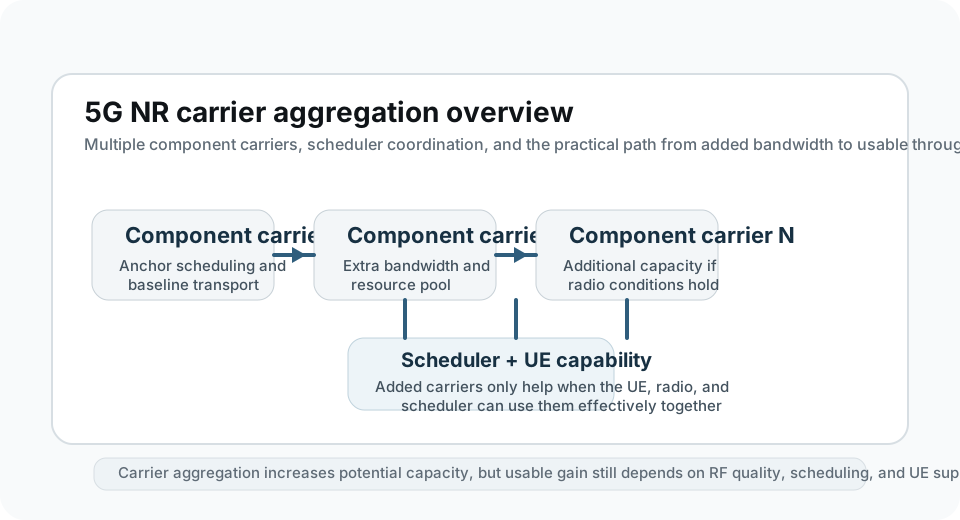
In practical terms, carrier aggregation lets the network combine multiple carriers so the UE can use more radio resources at once. That can increase throughput, but only if those carriers are all usable and coordinated well.
- CA combines multiple component carriers into one wider effective transport opportunity.
- It is different from just having one bigger carrier.
- It depends on UE support, scheduler decisions, and RF quality on each carrier.
- Engineers inspect CA when throughput does not scale with available spectrum.
Technical summary
| Role | Use multiple component carriers together to increase transport capacity |
|---|---|
| Main practical terms | Component carrier, inter-band CA, intra-band CA, scheduler coordination, UE capability |
| Most visible outcome | Higher potential throughput and more flexible resource use across carriers |
| Main dependencies | RF quality per carrier, UE support, scheduler behavior, carrier availability, mobility condition |
| Linked topics | PDSCH, PUSCH, throughput, BWP, numerology, MIMO, RF planning |
How carrier aggregation works in practice
Engineers should read CA as a multi-carrier coordination problem. Adding component carriers creates more capacity potential, but the final result depends on how well the scheduler can use them and how good each carrier actually is in the live radio environment.
Component carriers are the building blocks
Each aggregated carrier is a component carrier. The UE and network treat the overall CA setup as a coordinated multi-carrier operating mode rather than as one single flat carrier.
Scheduler coordination matters
CA gain is not automatic. The scheduler still needs to place useful traffic on the additional carriers and match that decision to the UE capability and the actual carrier quality.
Weak carriers reduce real gain
A second or third carrier only helps if it is strong enough to carry useful transport. If one component carrier has poor RF quality or unstable mobility behavior, the expected CA gain can collapse quickly.
CA and throughput are related, but not identical
Carrier aggregation raises throughput potential. Actual user throughput still depends on modulation, coding, spatial behavior, and how heavily the aggregated carriers are really being used.
Carrier aggregation variants engineers should understand
| Variant | What engineers should know |
|---|---|
| Intra-band CA | Multiple component carriers are combined within the same band |
| Inter-band CA | Component carriers come from different bands, which changes RF behavior and UE requirements |
| Two-carrier CA | The simplest common CA view and often the first step in throughput scaling analysis |
| Multi-carrier CA | Higher potential gain, but also more dependence on coordination and overall carrier quality |
| Balanced-carrier case | All carriers contribute meaningfully, so throughput scaling looks healthy |
| Uneven-carrier case | One or more carriers are much weaker, so theoretical CA gain does not become real user gain |
Where carrier aggregation matters in real procedures
- It matters during scheduled data transport on PDSCH and in some cases uplink transport on PUSCH.
- It should be read together with link adaptation because each carrier still needs usable transport choices.
- It often combines with MIMO when engineers evaluate throughput scaling.
- It depends on broader RF quality and planning assumptions, not only PHY scheduling logic.
- It becomes highly visible during throughput analysis, spectrum use analysis, and multi-band troubleshooting.
Mini sequence flow
UE capability + carrier configuration
   -> scheduler activates and uses component carriers
   -> data transport spreads across usable carriers
   -> throughput reflects carrier quality and coordination
   -> weak carriers reduce real CA gain
Real-world engineering examples
A site may show an apparently strong CA combination on paper, but the user still sees weak throughput because only the anchor carrier is consistently usable while the secondary carrier is weak or unstable.
Another common case is good CA potential in a static test but poor CA gain during movement. Mobility and band differences can make the secondary carriers less useful than the lab view suggests.
What to check in logs, KPIs, and RF analysis
- Whether all expected component carriers are actually active
- RF quality on each carrier, not just the anchor carrier
- Scheduler use of secondary carriers over time
- Whether throughput scales when extra carriers are present
- UE capability support for the CA combination under test
- Band-specific coverage or mobility weaknesses
- Whether MIMO and adaptation are healthy on the additional carriers as well
| Symptom | Likely engineering direction |
|---|---|
| Extra carriers configured but little throughput gain | Check whether the secondary carriers are actually scheduled and radio-usable |
| CA works in one area but collapses in movement | Check carrier-specific mobility and coverage behavior |
| Good anchor carrier, weak total CA performance | Check whether one or more secondary carriers have poor RF quality or scheduler use |
| Expected CA combination not appearing | Check UE capability, configuration, and band-combination support |
Common mistakes engineers make with CA
- Assuming extra configured carriers automatically mean extra user throughput.
- Looking only at the primary carrier and ignoring the condition of the secondary carriers.
- Confusing CA gain with MIMO gain even though they come from different mechanisms.
- Ignoring mobility and band-specific RF differences in CA troubleshooting.
Beginner takeaway
Carrier aggregation is how 5G NR combines multiple carriers to increase capacity potential. The real gain depends on whether those carriers are all usable, scheduled well, and supported by the UE.
Advanced engineer notes
- CA expands resource opportunity, but scheduler behavior still decides how much of that opportunity becomes real throughput.
- Inter-band CA should always be read with RF asymmetry in mind because different bands rarely behave identically.
- Weak secondary-carrier quality can make CA look present in configuration but absent in user experience.
- Per-carrier MIMO and adaptation health often explain why some CA combinations underperform.
FAQ
What is carrier aggregation in 5G?
It is the use of multiple component carriers together to increase effective transport capacity.
What is the difference between inter-band and intra-band CA?
Intra-band CA uses multiple carriers in the same band, while inter-band CA combines carriers across different bands.
Does carrier aggregation always improve throughput?
No. It improves throughput potential, but real gain depends on carrier quality, scheduler use, and UE support.
How do engineers troubleshoot weak CA gain?
They check whether all carriers are active, usable, scheduled effectively, and supported by the UE in the real radio environment.
Use the calculator and related tools
Carrier aggregation makes the most sense when you compare theoretical capacity with real scheduler use. Use the NR Throughput Calculator to test multi-carrier assumptions, then move into the 3GPP Decoder when you need to connect higher-layer procedures and radio behavior.