5G Beamforming - NR Beam Management, SSB Sweeping, and CSI-RS Beamforming
5G beamforming is the directional control of radio energy and spatial transmission behavior in NR. It affects how the UE finds the cell, how measurements are interpreted, how shared channels are carried, and how the network reacts when the current beam path starts to fail.
For beginners, beamforming is the reason 5G does not always behave like a simple wide, uniform coverage system. For experienced engineers, it is where SSB beam sweeping, CSI-RS, massive MIMO, uplink sounding, and beam failure recovery turn into real throughput and mobility behavior.
| Primary keyword | 5G beamforming |
|---|---|
| Main specs | 3GPP TS 38.211, 38.213, 38.214, 38.331 |
| Main concepts | NR beam management, SSB beam sweeping, CSI-RS beamforming, massive MIMO, beam failure recovery |
| Why it matters | Beamforming strongly shapes coverage, throughput, cell-edge behavior, mobility stability, and real user experience in NR |
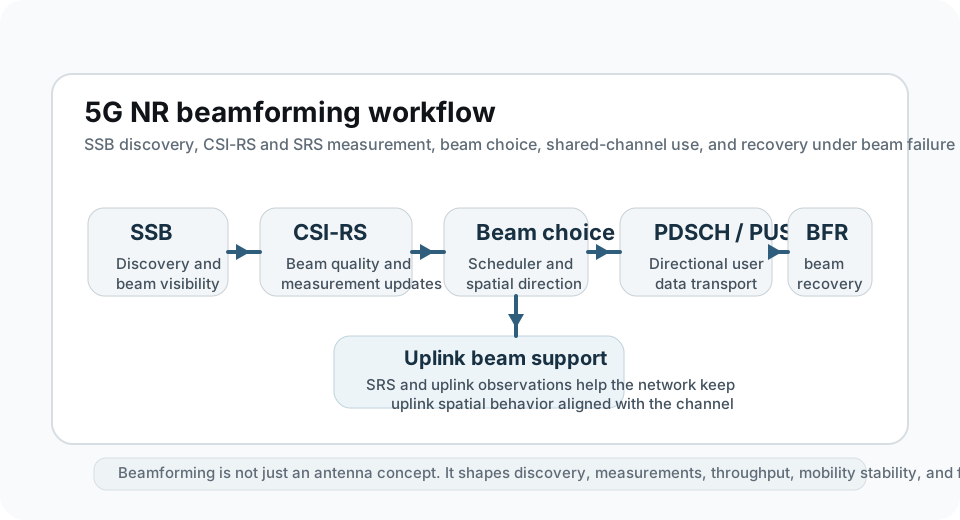
What beamforming means in simple terms
In practical terms, beamforming means the network does not radiate energy in the same way everywhere at once. Instead, it uses directional behavior to make the radio link more useful for a given UE location and channel state.
- It helps direct energy where it is most useful.
- It strongly affects coverage and throughput, especially in directional deployments.
- It is tied to discovery, measurement, scheduling, and mobility behavior.
- Engineers inspect it when users have unstable throughput, strange coverage holes, or mobility problems.
Technical summary
| Role | Use spatial direction and antenna resources to improve useful signal delivery and reception |
|---|---|
| Main visible signals | SSB, CSI-RS, and in many practical uplink discussions SRS |
| Main practical outputs | Coverage quality, beam stability, throughput, mobility smoothness, decode margin |
| Main failure symptoms | Uneven coverage, unstable CQI, beam switching problems, throughput collapse, HARQ pressure |
| Linked topics | SSB, CSI-RS, SRS, link adaptation, HARQ, PDSCH, mobility, troubleshooting |
How beamforming works in practice
Engineers should treat beamforming as a directional radio-management system, not just an antenna buzzword. The network exposes beam behavior through discovery signals, measurement signals, scheduling decisions, and later recovery actions if the selected path stops working well.
Discovery starts with SSB
In many practical NR deployments, the UE first sees beam behavior through SSB. Different SSB transmissions can represent different beam directions, which is why SSB visibility is often the first clue about beam coverage.
Measurement refines the beam picture
Once connected or in deeper radio observation mode, measurement-oriented signals such as CSI-RS help the UE and network understand how strong or weak the current directional path really is.
Scheduling benefits from a good beam choice
A stable beam often shows up indirectly through better CQI, better layer use, stronger transport efficiency, and less HARQ pressure. This is why beamforming and link adaptation should usually be studied together.
Failure recovery matters in the real network
Beamforming only helps if the system can react when the current beam path degrades. Beam failure recovery is therefore not an edge case. It is a practical reliability topic in live networks with movement, blockage, or fast-changing radio geometry.
Beam management flow engineers should understand
SSB beam sweeping
   -> UE sees candidate beams
   -> CSI-RS / later measurements refine quality
   -> scheduler uses the stronger spatial path
   -> PDSCH / PUSCH performance reflects beam quality
-> beam failure recovery triggers if the path weakens too far| Beam management stage | What it means in practice |
|---|---|
| SSB beam sweeping | The UE discovers directional coverage candidates instead of one flat coverage view |
| CSI-RS beam observation | Later measurements give more detailed insight into current beam quality and suitability |
| Scheduler beam use | Shared-channel behavior starts reflecting the beam path that currently looks most useful |
| Massive MIMO behavior | Spatial resources become part of how the cell serves users and manages capacity |
| Beam failure recovery | The system detects when the beam path has become unreliable and moves toward a better option |
Where beamforming matters in real procedures
- It matters during cell discovery and early access through SSB.
- It matters during measurement and beam-quality updates through CSI-RS.
- It influences shared-channel efficiency on PDSCH and PUSCH.
- It interacts with link adaptation and HARQ through real decode outcomes.
- It becomes highly visible during mobility and blockage scenarios, where beam stability matters as much as raw signal level.
Mini sequence flow
SSB beam visibility
   -> measurement and beam quality refinement
   -> directional scheduling and transport
   -> throughput / CQI / HARQ reflect beam quality
   -> recovery if the beam path degrades
Real-world engineering examples
A user can report strong coverage in one spot and poor coverage a few meters away because the effective beam path changed more sharply than a traditional wide-area coverage mental model would suggest.
Another common case is apparently random throughput instability that is actually beam-related. CQI swings, MCS oscillation, and HARQ pressure may look like generic radio instability until beam behavior is correlated with the same time window.
What to check in logs, KPIs, and field traces
- SSB visibility and whether expected beams are being seen
- CSI-RS quality and whether measurements look stable
- CQI fluctuation that may reflect beam instability rather than only interference
- MCS and layer behavior over the same interval
- HARQ retransmission pressure during suspected beam issues
- Mobility timing, blockage events, and directional coverage gaps
- Any signs of beam failure recovery or repeated beam loss patterns
| Symptom | Likely engineering direction |
|---|---|
| Coverage looks uneven | Check whether directional SSB visibility and beam geometry explain the observed holes |
| Throughput swings sharply | Check beam stability alongside CQI, MCS, and HARQ patterns |
| Good average RSRP but poor data stability | Check whether beam quality or beam transitions are weaker than the average signal level suggests |
| Sudden transport collapse after movement | Check beam switching and beam failure recovery behavior rather than only generic mobility counters |
Common mistakes engineers make with beamforming
- Treating beamforming as a pure antenna topic instead of a full radio-behavior topic.
- Looking only at average signal level and missing directional instability.
- Ignoring SSB and CSI-RS evidence when troubleshooting throughput or mobility issues.
- Assuming beam failure recovery is rare when it is often a practical field issue.
Beginner takeaway
Beamforming is how 5G NR makes radio delivery directional and more selective. It affects how the UE finds the cell, how the network serves traffic, and how performance changes when the spatial path becomes weak.
Advanced engineer notes
- Beam problems often appear indirectly through CQI instability, HARQ pressure, and inconsistent throughput.
- SSB beam sweeping and CSI-RS measurement should be read as connected parts of one beam-management story.
- Massive MIMO value depends on whether the radio and scheduling layers can actually exploit spatial separation well.
- Beam failure recovery is a practical performance topic, not just a corner-case spec item.
FAQ
What is beamforming in 5G?
It is the directional use of antenna and spatial transmission behavior to improve useful radio delivery toward the UE.
How is SSB beam sweeping related to beamforming?
SSB beam sweeping lets the UE observe different directional coverage candidates during discovery and early access.
Why is CSI-RS important for beam management?
CSI-RS helps refine beam-quality understanding after initial discovery and supports later adaptation decisions.
What is beam failure recovery?
It is the recovery process used when the current beam path is no longer reliable enough to support stable service.
Use the calculator and related tools
Beamforming is easiest to understand when you connect directional behavior to the transport outcome. Use the NR Throughput Calculator to relate beam quality to realistic throughput expectations, then use the 3GPP Decoder to connect radio behavior with the procedure context above it.